

A peace composition dedicated to a bourgeois group
Every month a member of the Carus team introduces his/her favorite work, whether it be a choral piece, a CD, a songbook or an instrumental work. The recommendation for August 2019 was contributed by Iris Pfeiffer.
Gib unsern Fürsten und aller Obrigkeit Fried und gut Regiment, daß wir unter ihnen ein geruhig und stilles Leben führen mögen in aller Gottseligkeit und Ehrbarkeit. Amen.
Grant to our people and all who govern us / Peace and good governance, / that we may under them / in all concord and peaceful spirit / live in safety, / in all truth and blessedness and faithfulness. Amen
Text: Johann Walter, 1566, according to 1. Tim. 2.2 (English version by Jean Lunn, as printed in Carus 20.373)
War raged on in Europe for thirty long years and caused a tremendous amount of damage in many areas, including Saxony. Heinrich Schütz, Kapellmeister at the Court in Dresden, composed many splendid works during the war years on the occasion of visits of political importance or in thanksgiving (in the last volume of the Schütz complete recording: Psalmen & Friedensmusiken, Vol. 20). Schütz offered all his art of polychoral composition in these representative, “political” works – their magnificent arrangement audibly shows what a precious commodity peace was.
For me, however, a completely different kind of peace composition has become my Schütz favorite: the five-part motet Gib unsern Fürsten SWV 373 (as secunda pars connected with the motet Verleih uns Frieden genädiglich SWV 372). It comes from the Geistliche Chor-Music, a collection of 29 motets, which Schütz published in the year of peace in 1648. The print of his Opus 11 dates to April 21, 1648; In October of the same year, the peace treaties were finally signed in Münster after many years of negotiations. The peace treaty, later referred to as the “Peace of Westphalia”, was a guarantee of stability in Europe for many decades.
With his Geistliche Chor-Music, for the first time, Schütz dedicated a collection not to a nobleman, but rather to a bourgeois group, namely the mayor and councilors of the city of Leipzig as well as the Thomaner choir, which he treasured. With this music, Schütz explicitly addresses the simple people who experienced all the horrors of war – as he did himself. The motet SWV 373 is anything but a representative composition, rather a silent, heartfelt request turned into music: that the mighty be given “a good regiment,” so that we ourselves may lead our lives in peace. The motets of Geistliche Chor-Music show a high degree of intensity in their expression – precisely because of their limitation in orchestration and form. The music clings closely to the words here, such as the imploring “Give” of the beginning, the deceleration when it comes to the “calm and quiet life,” or the eighth ascents to “leading,” which show the direction of our striving.
For me, this is a special treasure of “musicus poeticus:” small in its outer dimensions, but expressive music that has lost none of its power over 350 years since its composition; Music that is current given our confusing global political situation as never before; Music that you want the despots of our time to be sure to remember.

Iris Pfeiffer, musicologist, has worked at Carus since 2003. She is head of the “Business Development & Marketing” Department.
Schütz: Grant to our people
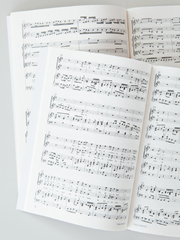 with singable english translation
Heinrich Schütz: Geistliche Chor-Music 1648 Complete recording (Rademann)
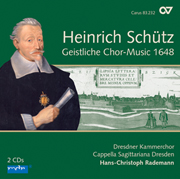 When it comes to paying tribute to Heinrich Schütz’s compositional achievement, in his art his treatment of the text and language must be mentioned first. The Geistliche Chor-Music, one of his most important works from the year 1648, is characterized by the carefully-thought-out musical realization of the meaning of the text.
Stuttgart Schütz Edition: Geitlische Chor-Music 1648 (Complete Edition, vol. 12)
 When it comes to paying tribute to Heinrich Schütz’s compositional achievement, in his art his treatment of the text and language must be mentioned first. The "Geistliche Chor-Music 1648", a collection of 29 motets for five to seven voices and one of his most important works, is characterized by he carefully thought-out musical realization of the meaning of the text.


We are currently learning this for a joint concert with a German choir, so I found this explanation really helpful, certainly a piece for our time as well as theirs. Thank you.
We wish you all the best and much success for the beautiful project! Your Carus Team