

Beethoven 2027
Beethoven’s big Anniversary in 2027: Inspiration for every Choir!
A choir named after Beethoven? Admittedly, he didn’t leave behind an extensive choral repertoire. Tristan Meister, director of the Beethoven Choir Ludwigshafen since 2017, set out to explore this question by delving deep into Beethoven’s choral works. His conclusion: The name is entirely justified – and with the anniversary year approaching, every choir (Beethoven choir or not!) should consider programming his choral works!
In 2017, just in time for the 190th anniversary of Beethoven’s death, I took over as conductor of the Beethoven Choir Ludwigshafen. Since then I have spent practically every spare minute trying to figure out why the founding members of this ensemble back in the early twentieth century came up with the idea of naming their choir after this particular composer, of all people. Granted, Ludwig van Beethoven is unquestionably one of the most important figures in the history of music, and he rightly deserves all honor! But surely not because of his choral works – after all, they were only a marginal part of his oeuvre, and they’re also notorious for being austere and unsingable. Despite this obvious misjudgment on the part of the decision-makers at the time, I managed to resist calling for the choir be renamed (after all, there are plenty of suitable, pleasant-sounding alternatives), and I set about getting to the bottom of the matter.
The reason for the name soon became clear: the choir’s first performance was Beethoven’s Ninth, and they’ve sung it more than fifty times since then. But this raises the question of whether a finale lasting about twenty minutes is enough to arouse such passion in a group of singers that they would choose to name their choir after the composer.
The answer is: well, yes. Not only must it have seemed like sheer madness on the composer’s part to add a choir and four soloists to a symphony at the time, but on top of that, this masterpiece broke almost all known musical and formal boundaries and had a formative influence on every single subsequent generation of composers. Fair enough then. But perhaps it was just a one-hit wonder?
Then there is the Mass in C major, which is not particularly spectacular, at least in terms of tonality. But musically it’s all the more exciting, at times lyrical and simple, at times fiery and animated, but always vivid, very close to the text and perfectly singable. A really fine, entertaining work that almost any choir should be able to manage! (And the Kyrie even has a truly remarkable tempo marking.)
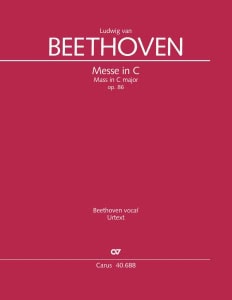
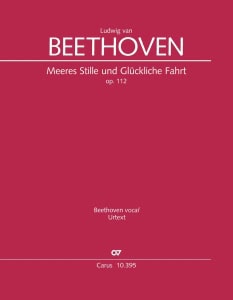
Ludwig van Beethoven
Meeres Stille und glückliche Fahrt
(Calm Seas and Prosperous Voyage)
Carus 10.395/00
Even Beethoven’s occasional compositions regularly turned out to be small masterpieces. His Choral Fantasy – actually a Fantasy for piano, choir and orchestra – is rarely performed due to its unconventional scoring and relatively short duration, but it’s groundbreaking in its innovative conception as a small piano concerto with choir, and it delights audiences and performers alike.
His choral ode Meeres Stille und Glückliche Fahrt (Calm Seas and Prosperous Voyage), based on two poems by Goethe, which was premiered together with the composer’s similarly underrated Passion oratorio Christus am Ölberge (Christ on the Mount of Olives), is another example of Beethoven’s genuinely creative handling of the choral medium: low tonality and long phrases paired with broad sweeping string chords represent the calm at the beginning, while driving motifs and almost inexpressibly fast phrases herald the “prosperous voyage”. An incredible piece!
But Beethoven’s skill was not restricted to large forces. His Elegischer Gesang (Elegiac Song) is an expressive, early Romantic gem for choir and strings, which also works wonderfully with piano. In fact, several smaller works have yet to be discovered by choir directors, audiences and publishers alike, and they offer a fascinating insight into the work of the very young Beethoven. The two so-called Emperor Cantatas from 1790 show that he was already interested in choral works at an early age, albeit with little success, as neither was performed during his lifetime. But Joseph Haydn was shown the cantatas on the death of Emperor Joseph II, and the biographer Franz Wegeler reports that he “paid particular attention to them and encouraged their composer to continue his studies”. From that point on, presumably to ensure that the young Beethoven received suitable training, Haydn accepted him as a pupil.
However we still haven’t mentioned the one work which stands above all others, not only for me and many Beethoven admirers, but also for the composer himself: the Missa solemnis, repeatedly described by Beethoven as his greatest work. Even after long engagement with the music, it still remains incomprehensible and fascinating – whether it’s the gracefully simple Kyrie, the colorful, joyful Gloria, the monumental Credo with its wild fugues, the solemn Sanctus, the dreamlike Benedictus and its hauntingly beautiful violin solo, or the Agnus Dei, which defies all expectations of form and ideas and still sounds crucially relevant today, with its echoes of war and desperate cries for peace.
Actually, this work alone is enough. I would, without hesitation, call my choir the Beethoven Choir, my festival the Beethoven Festival, and in the end I’d probably even call my house the Beethoven House.
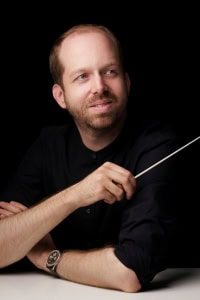
Tristan Meister is a lecturer in choral conducting at the music academies in Mannheim and Frankfurt am Main. He conducts several choirs, including the Beethoven Choir Ludwigshafen since 2017, and is a regular guest, workshop leader and course instructor at national and international choir festivals.
Ludwig van Beethoven: 9th Symphony (Choral Symphony)
When Friedrich Schiller published his Ode to Joy in 1786, the text struck a chord and quickly spread far and wide. It certainly resonated with Beethoven who considered setting it to music. However, it took decades for this to happen. In 1812 he wrote in a sketchbook: “Joy, beautiful spark of the gods – work out an overture.” In 1817 he began working on his Ninth Symphony, intensifying his efforts from the spring of 1823. Even during the premiere in 1824, Beethoven struggled with the decision of whether to end his symphony with a chorus, but he ultimately created a work of extraordinary significance.
Beethoven Choral Collection
 With their extensive forces and complex parts, the performance of Beethoven’s choral-symphonic works is hugely demanding for many choir. Carus has therefore expanded the repertoire of works available for mixed choirs. The Choral Collection Beethoven contains especially attractive arrangements of Beethoven’s music from three centuries.
Ludwig van Beethoven/Joachim Linckelmann (arr.): Missa solemnis
 With this arrangement for chamber orchestra (flute, oboe, clarinet, bassoon, horn, trumpet, trombone, timpani and strings, plus organ ad lib), smaller choirs, as well as choirs with more limited resources of space or finance, can perform this work too. However, the symphonic character and wide dynamic range of the work remain. All the vocal parts (soloists and chorus) are identical with the original version, so that the vocal score and choral score of that version can be used.
Ludwig van Beethoven / Gottlob Benedict Bierey (arr.): Kyrie
A sacrilege or a stroke of genius? The composer and music director Gottlob Benedict Bierey (1772–1840) orchestrated the first movement of the famous “Moonlight Sonata” by Beethoven (transposed to C minor) and added a four-part choral movement to it, which he underlaid with the text of the Kyrie from the Latin mass. The result is as astounding as it is harmonious!
Ludwig van Beethoven: Fantasie
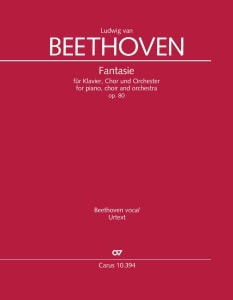
In a mixture of cantata and concert piece, Beethoven set a hymn to art in his Fantasie (Fantasy). The work, about 20 minutes in length, is often seen as a precursor to the Ode to Joy in the 9th Symphony. After a piano introduction, a dialog between piano and orchestra develops in the space of just 400 measures, before the soloists and chorus enter for the last 200 measures.


Leave a Reply
Want to join the discussion?Feel free to contribute!