

The Annunciation of the birth of the Savior Jesus Christ
The works by Schütz which Werner Breig most admires include the sacred concerto “Sei gegrüßet, Maria”. Schütz undoubtedly entered the Scuola Grande di San Rocco in Venice countless times, and anyone who entered it immediately saw Jacopo Tintoretto’s painting of the Annunciation. Did this image have a lasting impression on Schütz and his composition?
The works by Schütz which I most admire include his setting of a text which marks the begin-ning of the Christian story of salvation: the Annunciation of the birth of the Savior Jesus Christ to Mary, the one chosen as his mother. This scene has been depicted countless times in the fine arts, with the Archangel and the Virgin portrayed as of equal importance and on equal terms.
When composers began to compose settings of this text in the form of a dialog, that is, to allow the two protagonists themselves to speak (and mainly just as individuals), it transpired that the Archangel had much more text than Mary, and that the balance in the painted im-ages – which do indeed portray an equal ranking – is hard to achieve in a musical setting. Schütz regarded this as a problem which had to be solved if he was to do justice to the text. To achieve this he devised a highly original artistic treatment.
In his setting Mary reacts to Gabriel’s first words even before he has uttered his first greet-ing in full, and she sustains her reaction until the name of the expected son is given.
It is thanks to Luther’s less-than-precise translation that Schütz was able to introduce Mary into the dialog so early on. For strictly speaking (and here I cite the Zurich Bible in the 1931 version): “Sie erschrak über das Wort und sann darüber nach, was das für ein Gruß sei.” [She was troubled at his saying, and cast in her mind what manner of salutation this should be.] Luther also speaks of Mary’s feelings, but he gives these in the form of direct speech, probably beause of his preference for simple formulations: “Welch ein Gruß ist das?” [Hark, who haileth me?] In this form it was possible to compose music to match this idea – resulting in a highly unusual, not to say strange, musical version. It is a five-note ostinato in which we hear Mary “think aloud” five times. In fact we do not hear a real vocal melody, but a construct: five different notes, four different intervals, five notes within the range of a hexachord. The fact that this is not really a vocal melody, but a series of notes with text underlaid becomes clear because the descending interval from the third to the fourth note is a major sixth. This is a progression which was ‘forbidden’ in classical vocal polyphony of the 16th century, as it was considered to be unsingable – a rule which Schütz followed almost without exception. One of the characteristics of this five-note formula is that the rhythmic-metrical progression is in duple-time note values, and thus has the effect of slowing down the overall triple-time metre of the Angel’s message in an unconventional manner. You could almost say that Schütz composed a “motif for Mary” here, and that thanks to this, the first section of the piece is effectively the main focus of the composition and not merely a simple introduction to Mary’s ultimate agreement to take up her intended place in the history of salvation: “Mir geschehe, wie du gesagt hast.” [Be it to me as Thou wilt have it.]
One final thought: Giovanni Gabrieli was not only organist of San Marco, but he was also responsible for the music at the Scuola Grande di San Rocco. Schütz undoubtedly entered this building countless times, and anyone who entered it immediately saw Jacopo Tintoretto’s painting of the Annunciation. Did this image have a lasting impression on Schütz and his ap-proach as composer to the subject? We do not know.
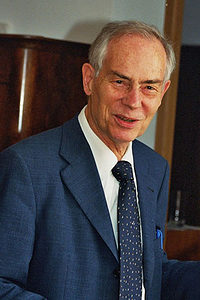
Prof. Dr. Werner Breig was Professor of Musicology at the Staatliche Hochschule für Musik Karlsruhe, then at the Bergische Universität Wuppertal until 1988, and subsequently at the Ruhr-Universität Bochum until 1997. The main emphasis of his research is he music of Heinrich Schütz, Johann Sebastian Bach and Richard Wagner.
Heinrich Schütz: Kleine geistliche Konzerte II. Complete recording, Vol. 17
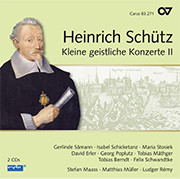 Heinrich Schütz’s compositions were hugely influenced by the horrors of the Thirty Years’ War. He continually assimilated his anxious and painful experiences into his works, but in the process created an optimistic, peaceful view of the future.
Heinrich Schütz: The annunciation
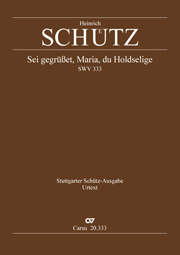 identical music to Ave Maria SWV 334


Leave a Reply
Want to join the discussion?Feel free to contribute!