

This richness in detail makes you speechless
Which work offers more than this? Claudio Monteverdi, who died shortly before the publication of the collection, would probably have been astonished about this congenial “German” adaptation of the seconda prattica. From the collection, which Schütz compiled over many years, each work has become so dear to the heart of Frieder Bernius that he is spoilt for choice if he has to select just one.
A favorite work by Heinrich Schütz? That would probably have to be one of the works which Schütz himself described as “von heutiger Manier der Composition” (in the contemporary style of composition) and “de Musica Moderna” (of modern music): his Symphoniae sacrae “tertia pars”, published in 1650, in which he shaped the ideas he had brought with him from Italy to create an indisputable high point of German music of the 17th century. From the collection which he compiled over many years, each work has become so dear to my heart that I am spoilt for choice if I have to select just one – in the same way that it would be impossible and wrong to choose one of your own children over the others.
When I saw the third setting of these, “Wo der Herr nicht das Haus baut…”, SWV 400, a setting of Psalm 127, for the first time, I was dumbfounded by the abundance of harmonic, metric, rhythmic, and rhetorical details found in this score. Was this the same composer who had primarily gained his “image” through honest, large-scale traditional motet performances, which had hindered my appreciation of his music for such a long time?
But what we have here is a complete contrast: the concertante style of a two- to three-part solo, or favoriti, choir, instrumental and vocal writing interwoven in the finest style, likewise the most subtle semantic relationships at the cornett call of the watchman, the rhetorical pauses after “umsonst” (in vain), the almost two-octave scale on the word “lange” (long), chromatic ascending harmonies (via G sharp minor!) at “mit Sorgen euer Brot essen” (to eat the bread of sorrows), piano diminishing unisons on “gibt er’s schlafend” (he giveth his beloved sleep), rhythmic rocking melismas on “Kinder” (children), racing coloraturas, chasing each other at “Pfeilen in der Hand eines Starken” (arrows in the hand of a mighty man).
The work begins with a Symphonia in which the whole wealth of instrumental color – violins, cornetts, and gambas as an instrumental ‘complementum’ group ad lib – is placed before the imitative writing of the two sopranos; these reprise the first rhetorical figures – melismas at the word “bauen” (build) and the constant motivic repetitions for “umsonst” (in vain). But the instruments not only play first, but also provide expressive commentaries, as at “Essen des Brotes mit Sorgen” (to eat the bread of sorrows). This variety does not end there: a vocal complementum choir, which can be placed spatially separated, reinforces the solo, or favoriti, choir in the first part of the phrase “Denn seinen Freunden giebet er’s” (for so he giveth his beloved) sung forte, which the solo choir completes with increasing note values at the word “schlafend” (sleep). And at the concluding high point of the work, “Wohl dem, der seine Köcher derselben voll hat” (happy is the man that hath his quiver full of them), all the groups combine, declaiming together in highly artistic fashion as well as in the syllabic and melismatic phrases tossed from one group to another.
Which work offers more than this? Claudio Monteverdi, who died shortly before the publication of the collection, would probably have been astonished about this congenial “German” adaptation of the seconda prattica
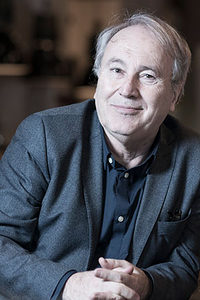
Frieder Bernius is in great demand worldwide as a conductor, seeking a sound which is both authentic and at the same time distinctive and personal – whether in the vocal works of Monteverdi, Bach, Handel, Beethoven, Schütz, or Ligeti, the incidental music of Mendelssohn, or the symphonies of Haydn and Schubert. Bernius has conducted the complete recording of the sacred vocal music of Felix Mendelssohn Bartholdy and many other recordings of works by a huge variety of composers, and is also editor of many music editions published by Carus-Verlag, including Mozart’s Mass in C minor KV 427.
Schütz: If the Lord build not the dwelling
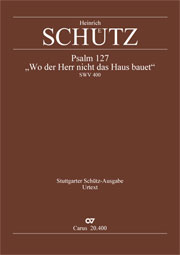 Psalm-concert
Schütz: Symphoniae Sacrae III. Complete recording, Vol 12 (Rademann)
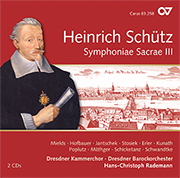 The twelfth part of the acclaimed complete recording of works by Heinrich Schütz contains the Symphoniae sacrae III. With this recording, the Dresdner Kammerchor under Hans-Christoph Rademann, supported by well-known soloists, has devoted itself to one of the pinnacles of German early Baroque music.
Stuttgarter Schütz-Ausgabe Der 119. Psalm (Gesamtausgabe, Bd. 18)
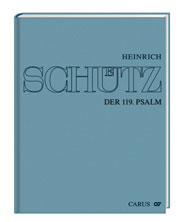 Heinrich Schütz beendete 1671 86-jährig sein kompositorisches Schaffen mit der monumentalen Vertonung des 119. Psalms, in einem Anhang ergänzt um die Vertonung des 100. Psalms sowie die eines deutschen Magnificat. Von den acht Vokalstimmen der “Schwanengesang” genannten ganzen Werkgruppe sind zwei verlorengegangen, sodass diese in der erhaltenen Fassung nicht aufführbar ist.


Leave a Reply
Want to join the discussion?Feel free to contribute!