
Universal Funeral Music
Johannes Brahms: Ein deutsches Requiem (A German Requiem)
At a length of around an hour and twenty minutes, Johannes Brahms’s German Requiem leaves room for additional concert programming. An examination of its performance history reveals some innovative combinations, motivated by either practical considerations or artistic vision. Yet the question of a meaningful companion piece in a concert program remains relevant even today.
Performance History
85 performances by 1876. Johannes Brahms’s A German Requiem, Op. 45, was undoubtedly one of the most successful compositions of its time. Yet its early reception wasn’t particulary favorable. “Three Movements from A German Requiem” were performed for the first time on December 1, 1867, at a memorial event for Franz Schubert in Vienna. They were presented as an unfinished work in the concert hall and paired with Schubert’s Rosamunde, and the reaction was subdued.
But things soon turned around. In August 1867, Brahms had already sent the work, which at that stage still consisted of six movements, to Albert Dietrich, with the entreaty, “Please write me in all seriousness what you think of it.” What Dietrich thought of it soon became clear: he passed it on to the conductor Carl Reinthaler. As a result, the world premiere took place on Good Friday, 1868, in Bremen Cathedral, before the crème de la crème of the music world, including Clara Schumann and Max Bruch. At the subsequent supper Reinthaler described it as an “epoch-making work”. One reviewer even remarked that “Robert Schumann’s prophetic words in his musical testament [i.e. his essay Neue Bahnen (New Paths)] have […] been fulfilled.” The music was said to be “as skillful and serious as that of Bach, as sublime and powerful as Beethoven’s Missa solemnis, enriched throughout in Schubertian style with melody and harmony.” Compared with the canon of the most celebrated composers, Brahms had come a good deal closer to his compositional breakthrough.
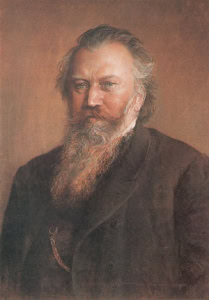
Johannes Brahms
1833 – 1897
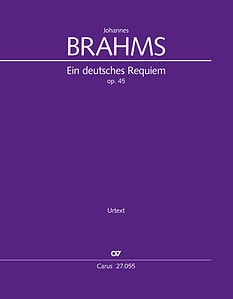
Johannes Brahms
Ein deutsches Requiem
(A German Requiem)
Carus 27.055/00
Arrangement for chamber orchestra
(arr. J. Linkelmann)
Carus 27.055/50
Arrangement of the orchestral
part for two pianos
(arr. A. Grüters)
Carus 23.006/03
Arrangement for piano four hands
by the composer
Carus 50.999/00
However the work was still considered musically incomplete. Brahms’ contemporaries felt that what was missing above all was a reference to the Redeemer’s death. In short, the Requiem was not religious enough: “If Christ has not been raised, your faith is in vain,” Reinthaler warned, quoting Paul. For this reason, an aria from Bach’s St. Matthew Passion and the Hallelujah from Handel’s Messiah were included in the Bremen program. Why? Brahms, seeking to convey a consoling and universal message, had deliberately dispensed with the liturgical text of the Catholic Mass for the Dead. Indeed, he stated that he would “quite gladly omit even the word ‘German’” and instead simply substitute “human.”
Nevertheless, partly in response to the criticism, he expanded the Requiem to include the great soprano aria Ihr habt nun Traurigkeit (Ye now are sorrowful). This version of the work was performed in Leipzig on February 18, 1868. The turmoil of the Franco-Prussian war in 1870–71 further fueled its subsequent success: a musical Requiem in the vernacular seemed highly relevant for commemorating the fallen. The thoroughly patriotic Brahms further promoted this with a concert on April 7, 1871, in Bremen, “In memory of those fallen in battle.” Here he directly intertwined religious and political elements and supplemented the program with the Hallelujah from his still unfinished Triumphlied, the subtitle of which was originally intended to be “On the Victory of German Arms.”
The debate over the appropriate program pairing with the Requiem continued well into the twentieth century: one memorable combination was, for instance, with Arnold Schoenberg’s Ein Überlebender aus Warschau (A Survivor from Warsaw). Brahms, himself considered a standalone performance of the Requiem to be ill-advised, not so much for religious reasons as for pragmatic ones: “I still think the Requiem alone would be too little for your audience! It lasts about an hour and quarter.”
Johann Sebastian Bach: Magnificat in d major
Johann Sebastian Bach’s Magnificat BWV 243 was composed in its first form in E flat major, right at the beginning of Bach’s period in Leipzig, possibly for the Visitation of Mary on July 2, 1723. Its performance on Christmas Day 1723 is well documented. Following a Leipzig tradition, Bach wrote four extra Christmas movements for this occasion.
Johann Sebastian Bach: Watch now, praying, praying, watch now BWV 70.2
First performed on the 26th Sunday after Trinity in 1723, Wachet! betet! betet! wachet! (Watch now, praying, praying, watch now), BWV 70.2 is in two-parts. The cantata’s first part is heard before the sermon and the second after. This form is due to the work’s history. Originally composed for the second Advent Sunday in 1716, the cantata was expanded from 6 to 11 movements with some textual additions to create recitatives and an additional chorale at the end of the first part.
Johannes Brahms: Song of Destiny
With the Schicksalslied (Song of Destiny), Brahms created a very personal interpretation on the theme of fate in a timeless piece of music that will not fail to impress in concert hall or church. The present edition is a modern Urtext edition of the score based on current editorial principles. It is based not only on the composer’s personal copy of the first edition as the primary source, but also on the engraving manuscript which was long thought to have been lost. Thus the composer’s handwritten corrections made in this manuscript could be incorporated in the new edition, as well as a revision in this bilingual edition of the English translation of Friedrich Hölderlin’s dramatic poem.
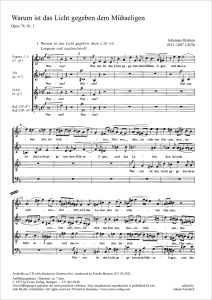
Johannes Brahms: Warum ist das Licht gegeben dem Mühseligen
George Frideric Handel: Messiah
George Frideric Handel is considered England’s first and foremost composer of oratorios. Above all, the Messiah is regarded as the epitome of sacred music and in German-speaking countries it is also one of the most often performed works in the genre. The work is available from Carus in a modern Urtext edition, edited by the internationally renowned early music expert Ton Koopman.
Johann Sebastian Bach: St. Matthew Passion

Every era hears and interprets Bach anew, and every era also evaluates the sources afresh and with new eyes. Klaus Hofmann, Director of the Johann Sebastian Bach Institute Göttingen for many years and a contributing editor to the New Bach Edition, presents his edition of St. Matthew Passion with Carus. Hofmann has placed the study of the sources at the service of musical practice and the detailed investigation of Bach’s intentions.
Johannes Brahms: Sacred Choral Music
All the sacred motets by Johannes Brahms are published together here in one anthology: from the early
Ave Maria of 1858 to the Three Motets op. 110 written over 30 years later. Karl Michael Komma has provided a detailed introduction to each work, placing each one in the context of Brahms’s overall output.


Leave a Reply
Want to join the discussion?Feel free to contribute!