

Comfort with Gentleness and Dignity
If you have edited as much music as Klaus Hofmann has, you have many favorite pieces. As an editor, you become extremely close to the music – how could it be otherwise – and often you have the impression that it is simultaneously approaching you. So it’s no surprise when it really captures your heart. That is how pieces develop into favorite pieces.
If you have edited as much music as I have, you have many favorite pieces. As an editor, you become extremely close to the music – how could it be otherwise – and often you have the impression that it is simultaneously approaching you. So it’s no surprise when it really captures your heart. That is how pieces develop into favorite pieces.
I had been familiar with one of these favorite pieces, Telemann’s cantata Du aber, Daniel, gehe hin, for a long time and had even performed it myself when I decided to publish my own edition of it. The work only survives in a contemporary copy, so we do not know anything about the time and conditions surrounding its composition. But it is clear that it is funeral music. The person being mourned, as emerges from the text, is a well-respected official and dignitary, probably with the first name Daniel. But we do not know any more than this. As a scholar, one might regret this; but as a listener you can and should allow your imagination to roam.
Telemann’s cantata does indeed address the deceased, but it is directed towards the living. It endeavors to reconcile the mourners with death and seen in this light, it is more music of comfort than funeral music. The introductory biblical text from the Old Testament Book of Daniel establishes a timeless perspective with the promise, “thou shalt … stand in thy lot at the end of the days”. In the following recitatives and arias, typical motifs of the time recur, which we are also familiar with from the music of Bach: renunciation of the world, longing for death, longing for the hereafter; and at the end there is a farewell in hope: “Schlaft wohl, ihr seligen Gebeine, bis euch der Heiland wieder weckt”. [“Sleep well, you sacred limbs, until the Savior wakes you again”.]
Telemann gave his all. His music radiates peace, solemnity, gentleness, and dignity. The four-part chorus and solo voices of soprano and bass are joined by an exquisite chamber music instrumentation of recorder, oboe, bassoon, two gambas and basso continuo.
The sonata for instruments at the beginning is full of ceremonial solemnity, and the chorus also begins in festive mode with the biblical words “Du aber, Daniel, gehe hin”, but the writing becomes more lively when it reaches the text about the forthcoming resurrection. The bass has a grand “scene” in several sections, centered around the arioso “Komm, sanfter Tod” inspired by the sense of longing for the hereafter. However, the soprano aria “Brecht, ihr müden Augenlider” is a masterpiece of Baroque tone-painting: whilst the voice dialogs with the oboe, the gambas portray in restless figurework the disquiet of the human spirit, which only comes to rest with death, and the recorder, violin and continuo represent the “closing” of the eyelids, signifying the passing away of the deceased. The conclusion is formed by the “Schlaft wohl”, a wonderfully sonorous chorus of cantabile simplicity and warmth. The strings sound the death knells pizzicato, and above all this float the exquisite cantilena lines of recorder and oboe.
The reconciliation with the inevitable, which the cantata text attempts in its own way, is achieved by Telemann with the beauty of his music.
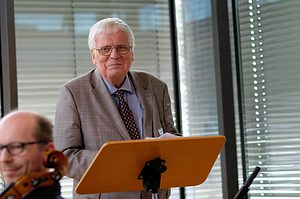
Prof. Dr. Klaus Hofmann studied Musicology, Modern German Literature and Copyright and Publishing Law in Erlangen and Freiburg. Since 1994 he has been an honorary Professor at the Georg-August-Universität Göttingen. He is a freelance editor for Carus-Verlag.
Du aber, Daniel, gehe hin
 With the final verse of the Book of Daniel from the Old Testament and a related cantata text, Telemann mourns the death of a prominent, but until now unknown dignitary in a cantata marked by great intimacy and with exquisite instrumentation.


Leave a Reply
Want to join the discussion?Feel free to contribute!