
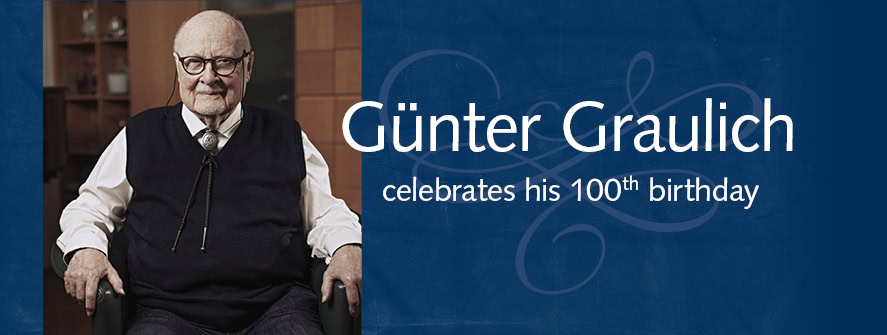
Günter Graulich on his 100th birthday
A brief portrait of his “polyphonic” life, with original quotes from the honoree.
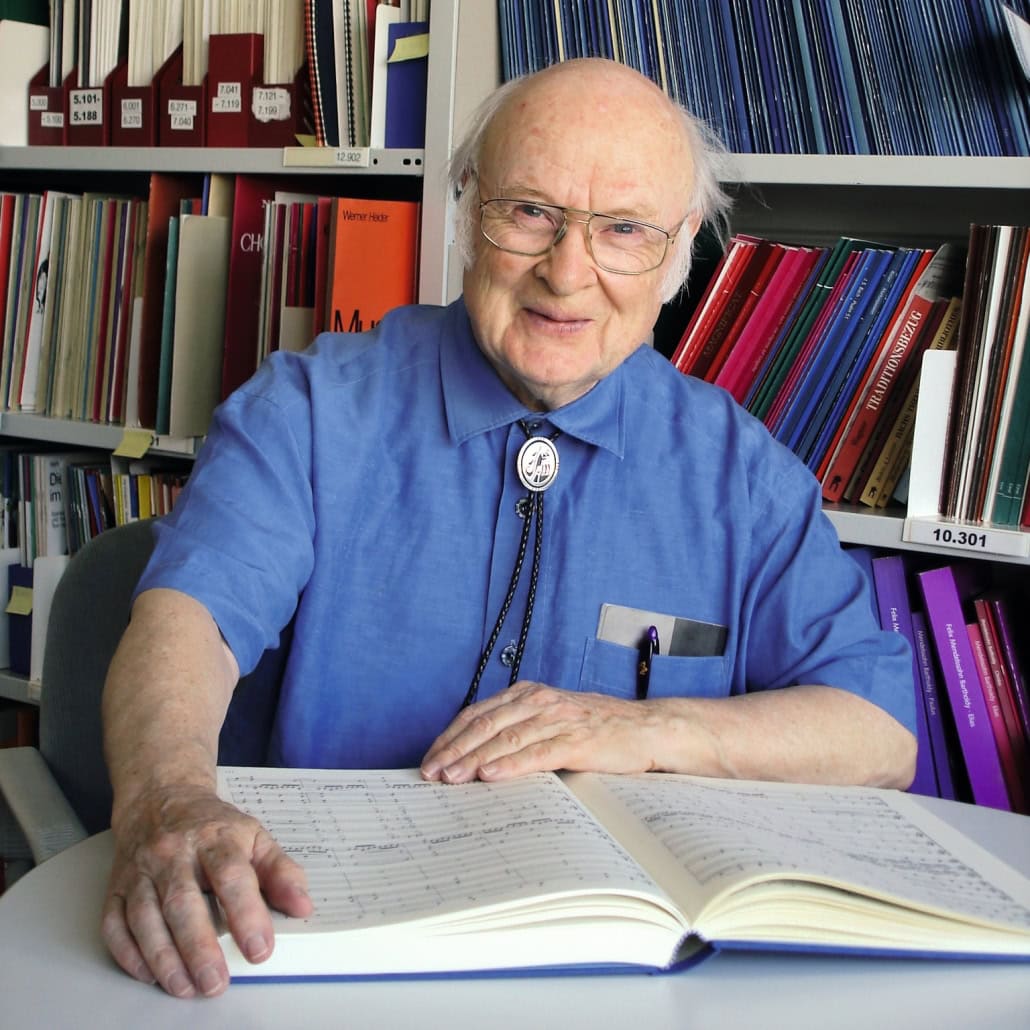
On July 2, 2026, Günter Graulich celebrates his 100th birthday. Finding the right words to describe this remarkable man, even after many years of acquaintance, is both difficult and surprisingly easy. Difficult, because it’s hard to capture the “polyphony” of his rich, colorful life, with his extraordinary range of professional and private pursuits – and yet easy, because Günter Graulich is such an approachable and engaging person! We asked him to describe himself in just a few words, and his response shows why we want to let him speak for himself throughout this brief tribute to a great music publisher. With a good dose of the humor which has always been his hallmark, he offers the following self-portrait:
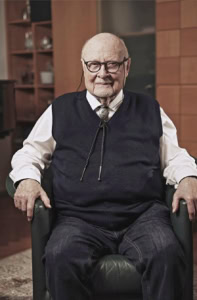
Günter Graulich
*2nd July 1926
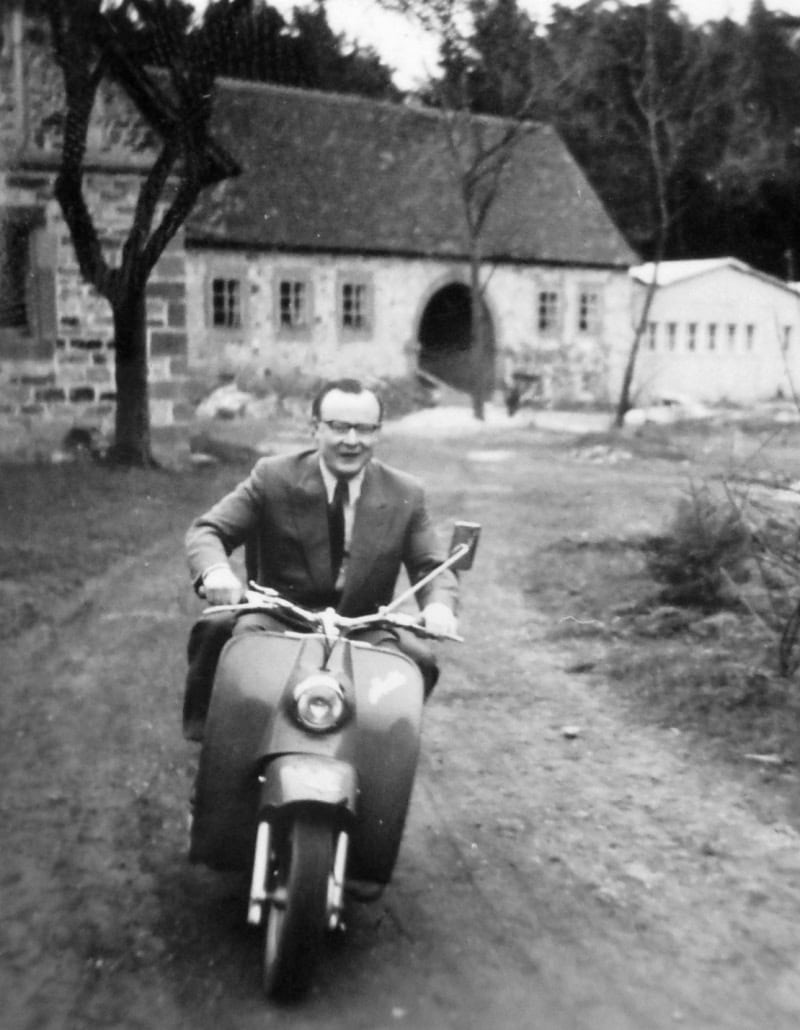
Music has fascinated him throughout his life, in the broadest possible sense. His boundless curiosity is matched by his constant commitment to excellence. In his younger years, he served as cantor at Stuttgart’s Matthäuskirche. For many years, he was simultaneously a choir singer and conductor, a high school teacher, and yet a student when it came to editing music. In 1972, at the age of 46, he founded Carus-Verlag together with his wife, Waltraud. Together, they carefully set the course for the company, guiding its development over the decades that followed. The underlying principle for absolutely every step was always profound enthusiasm, coupled with a sound commitment to quality.
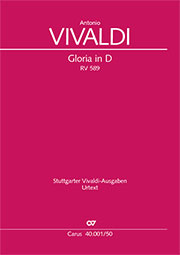
But Günter Graulich always listened attentively to others as well – to his colleagues in the editorial, production, marketing, sales, distribution, rights, and licensing departments, and to the countless people, from performers to academic scholars, with whom he forged connections over the course of his long professional career. He was always open to suggestions. In 1968, for instance, during a social gathering after a concert which he had conducted, the alto soloist mentioned a work by Vivaldi that she had sung in Switzerland which might also be suitable for Stuttgart. Graulich, never one to separate work and leisure completely, pricked up his ears:
Thus it was that the publishing venture began with Vivaldi, initially supported through Hänssler Verlag, but this first work represented an editorial bridge leading to the founding of Carus-Verlag by Günter and Waltraud Graulich in 1972. In fact, this Vivaldi edition was the first scholarly-critical edition of the Gloria, a work which is now beloved by choirs around the world.
This enduring bestseller in the Carus catalog demonstrates the instinct that has distinguished the Graulichs from the very beginning. Without that instinct, this single seed could never have grown into an impressive catalog of more than 45,000 titles. We can’t possibly identify a secret formula for such success, but it was significant that certain elements in Graulich’s life began informing and inspiring one another. His association with the Stuttgart Motet Choir, spanning over half a century with numerous concerts and choral tours, showed Graulich the practitioner where gaps existed in the available repertoire. If there were no practical performing editions of certain works, he didn’t rest until those gaps were filled with new editions, generally testing out the results with his own choir.
Günter Graulich was always keen to seek collaboration with other ensembles and conductors – with Helmuth Rilling and Robert Levin on the completion of Mozart’s Mass in C minor; with Frieder Bernius, with whom he championed the cause of Mendelssohn, with Hans-Christoph Rademann and the Dresden Chamber Choir regarding the complete recording of Schütz’s works; with the Max Reger Institute in Karlsruhe and the Calmus Ensemble, among many others.
He was always open to new ideas, which often proved extremely successful, such as the Freiburger Chorbuch (Freiburg Choral Collection), which sold 100,000 copies over several years with Carus. He had an intuitive sense of when editors needed time for a project to mature, and when it was necessary to tighten the reins, so that the shared goal (and the goal was always a shared one!) could be achieved.
His staying power is another important factor. The athlete in Graulich, who even as a grandfather could still do a handstand with ease, may well have been instrumental in this regard. Some projects pursued with conviction have taken years or even decades, as was the case with Mendelssohn:

In addition, that project also included the German translation of Larry Todd’s biography of Mendelssohn, a scholarly and highly readable standard work. Other similarly ambitious projects include editions of the sacred music of Heinrich Schütz and of the Bach family, as well as that of Mozart, Schubert, Beethoven and Haydn, among many others; the complete Rheinberger edition; the hybrid Reger edition; and the five books comprising the Basiswissen Kirchenmusik (Basic Knowledge of Church Music), to name just a few examples.
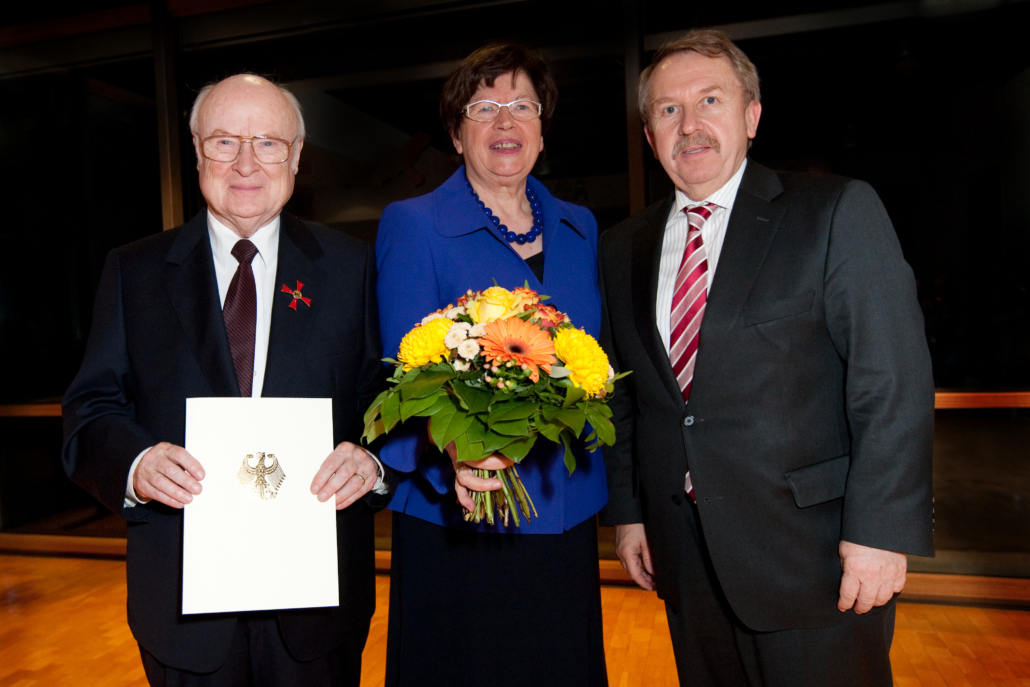
As a church musician and educator, but even more so as a publisher and visionary, Günter Graulich has influenced and shaped the preservation and dissemination of vocal music like few others. As a responsible employer, he was able to create and nurture an environment beneficial to staff and customers alike. His Swabian-Protestant background has remained an important influence, complemented with a broad ecumenical outlook. His life’s work extends far beyond Stuttgart. Choral singers everywhere know him – maybe not personally, but certainly through his sheet music editions. He has been honored in multiple ways for his lifetime achievements: for example, he has been awarded the German title of Director of Church Music, the Orlando di Lasso Medal from the German-speaking Associations of St. Cecilia, and the German Federal Cross of Merit, First Class.
Günter Graulich’s own preferred tempo marking may well be vivace assai, but he himself calmly radiates a profound trust in God and an enduring love of music that is deeply rooted in a century of life experience:




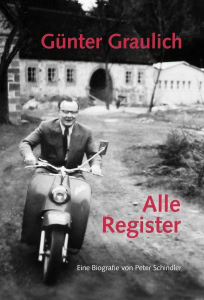
* The quotes from Günter Graulich are taken from Günter Graulich: Alle Register. A biography by Peter Schindler.


Leave a Reply
Want to join the discussion?Feel free to contribute!