

Cherubini’s Risk
When Nicole Däuber encountered Luigi Cherubini’s first Requiem in C minor as a musicology student in Heidelberg, she was fascinated by its special musical form and compositional refinement. The work became extremely well-known amongst the composer’s contemporaries, and was performed at the funeral of Beethoven, one of Cherubini’s greatest admirers, and on several other occasions.
When I encountered Luigi Cherubini’s first Requiem in C minor as a musicology student in Heidelberg, I was fascinated by its special musical form and compositional refinement: the atmospheric homophonic beginning of the chorus in its low range, which expresses mourning on the loss of the deceased.
Cherubini composed the Requiem in 1816 for a church memorial ceremony on the anniversary of the death of Louis XVI, who was executed during the French Revolution. Although the ceremony took place in the church of St. Denis in Paris, where women were forbidden to sing at that time, the scoring is for a mixed chorus and a large orchestra, but without soloists. As well as this, Cherubini employs graphic, vivid writing in his Requiem, which was also atypical for a church composition. At the beginning of the Sequence (3rd movement), the Last Judgement is portrayed programmatically with a tamtam stroke. The church objected to these two distinctive features, as a result of which Cherubini composed his second Requiem in D minor just for men’s voices.
Despite deviating from the liturgical tradition, in the prelude to the Sequence the composer integrates a concise and sombre melody which had been used in setting the Sequence since the first half of the 13th century: the distinctive semitone step is heard and repeated, followed by the typical descending fourth. Other composers, such as Wolfgang Amadeus Mozart, Hector Berlioz and Giuseppe Verdi, also used the motif for its memorability, and not only in Requiem compositions. This motif is also often used in symphonic works, such as Sergei Rakhmaninov’s The isle of the dead.
As well as the full score, Carus offers a vocal score and the complete orchestral material, in addition to a study score and an excellent recording in Super Audio Surround Sound (SACD) with the Kammerchor and Hofkapelle Stuttgart conducted by Frieder Bernius.

Nicole Däuber has worked as a student trainee in the Marketing Department since February 2016.
Paritur
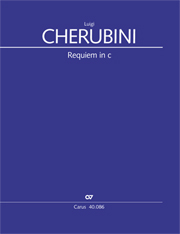 Cherubini’s Requiem in C minor for mixed choir (without vocal soloists) and orchestra, which is presented here in a critical new edition, is among the most significant contributions to this genre in the 19th century. It was composed in Paris in 1816 and within a short time it became well known. Musicians such as Beethoven, Schumann and Brahms held it in high esteem because of the work’s superior compositional construction, orchestration, mastery of form and the balance in proportion between text and music.
CD
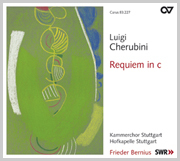 Ludwig van Beethoven regarded Luigi Cherubini (1760–1842) as the greatest composer of his epoch. Marking the 250th anniversary of his birth (14 September 2010), this new recording of the Requiem in C minor pays homage to the composer who is regarded equally as a “conservative revolutionary” and “prophet of the romantic”.
App
 Cherubini’s Requiem was composed for the church memorial ceremony on the anniversary of the death of Louis XVI. The work contains some special features which traditionalist clerics of the time objected to, such as the scoring for mixed chorus and the graphic depiction of the Last Judgement in the music. There are no soloists, so the choir alone has to master all the demanding passages.


Leave a Reply
Want to join the discussion?Feel free to contribute!