

Dvorák’s “Bagatelles”
You can read about our colleague Isabelle Métrope’s experiences as a teenager in her final examination on viola at a French music school playing the Romantic Pieces op. 75 by Antonín Dvorák!
As a teenager, when I was completing my final examination in my study of the violin at a French music school students were required to perform three works before a jury: the first movement of a concerto from the standard concerto repertoire (e.g., Bruch, Mendelssohn, etc.), a movement from a sonata or partita by J. S. Bach, and a third piece of their choice from any style and era. The latter selection offered performers the chance to display their musical expression… and perhaps to earn extra points to make up for a level of technique which they did or could not fully demonstrate in playing their first two selections. In this third category, for my exam I chose Antonín Dvorák’s four Romantic Pieces , op. 75.
A chemistry student who lived in the home of the Dvorák family in Prague took violin lessons and, though a dilletante, he played most passionately. Entirely in the sense of domestic music making, Antonín Dvorák, with a newly-composed trio in his hand, joined both student and violin teacher to play. This is the background of the genesis of the four small pieces, which later, in a modified form would achieve an unforeseen future.
“Now I am writing little ‘bagatelles,’ just imagine: for 2 violins and viola. This work brings me as much joy as writing a large symphony. Of course the pieces are conceived more for amateurs, but did not Beethoven and Schumann also once write for very modest ensembles, and how…?” Thus Dvorák offered this string trio to Simrock, his publisher in Berlin, prior to rewriting it for violin and piano. This new, largely revised and more demanding version he entitled Romantic Pieces , after which the original trio fell into oblivion. The new version was premiered in Prague in 1887 and published by Simrock shortly thereafter.
The first movement of the Romantic Pieces , with the tempo marking “Allegro moderato,” lives up to title of the entire work; it opens the cycle with melancholy intervals and intense melodic lines. The second movement forms a contrast, a defiant “Allegro maestoso” whose dancelike, but proud character make it a most special and demanding piece. The more serene ending prepares the way for the following, tonally beautiful “Allegro Appassionato.” The sighing final movement, the musical climax of the work, follows with its double stops an octave apart. This is a Larghetto whose rhythmic motive – two eighth notes with a sixteenth-note appoggiatura – appears throughout the piece, sounding at various dynamic levels. In spite of this persistent rhythmic leitmotiv, its musical expression of sadness is never boring – although the final note of the violin remains unresolved on the dominant…
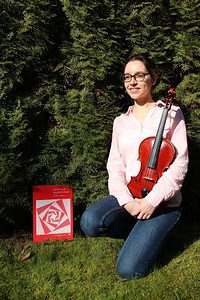
Isabelle Métrope studied music management, choral conducting, as well as vocal pedagogy and has worked since September 2014 at Carus in the areas of communication and event planning.
Paritur
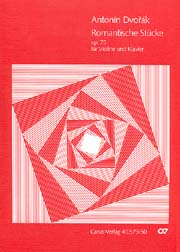 Dvořák composed his Romantic Pieces op. 75 for violin and piano in 1887 for Josef Kruis, a chemistry student and keen amateur violinist who was the lodger of Dvořák’s mother-in-law.


Leave a Reply
Want to join the discussion?Feel free to contribute!