

Monteverdi’s Vespers 1610 “light”
Alternatives for a Smaller Scale Performance
Monteverdi’s Vespers from 1610 is one of the few works of its time that belongs to the informal canon of pieces that almost every choir dreams of performing at least once. But the obstacles are considerable. The work is polyphonic, challenging, and requires not only a high number of soloists, but also a relatively large orchestra, including some instruments that are still rather rare and therefore expensive. However Monteverdi’s Vespers can also be performed with considerably less outlay. In fact, Monteverdi himself provided less elaborate alternatives. Carus chief editor Uwe Wolf highlights some possibilities.
Continuo version
The idea that Monteverdi may have already created a continuo version of his Vespers is not new. “SV”, the small catalog of Monteverdi’s works by Manfred Stattkus, even lists a separate continuo version of the Vespers under the number SV 206a. Stattkus presumes this second version from the different performance spaces mentioned in the title: ad Sacella sive Principium Cubicula accomodata, or “suitable for chapels or princely chambers.” He supports his thesis by noting that the ritornellos in the Dixit Dominus are marked ad libitum, and further that there are two versions of the Magnificat in the 1610 publication: in addition to the colorfully orchestrated Magnificat with 12 obbligato instruments, there is another setting with continuo only, and also with only six instead of seven voices. Stattkus’ argument is not entirely convincing – the ten-part Nisi Dominus in princely chambers? Why no variants for the introit, sonata and hymn? It’s more likely that Monteverdi had in mind the practice of performing only sections of the Vespers as a rule, and the parts with variants, i.e. the Dixit and the Magnificat, were the ones that were performed particularly frequently.

Bassus Generalis:
Frontpage (1610)

Claudio Monteverdi
However, there is nothing to stop us today from extending Monteverdi’s approach to the entire Vespers:
| 1 | Introit Deus in adjutorium / Domine ad adjuvandum me festina | can be omitted or performed as a falsobordone, with organ ritornellos if desired |
| 2 – 10 | Sequence of psalms and small-scale concerti | Dixit without ritornellos, otherwise everything can remain the same |
| 11 | Sonata sopra Santa Maria | must be omitted (not a liturgical part of Vespers); if necessary, add an organ piece instead |
| 12 | Hymnus | without ritornellos (or only organ ritornellos) |
| 13 | Magnificat |
use Magnificat à 6 instead of Magnificat à 7 |
Which soloists are needed?
The psalms and the Magnificat can be sung by a choir, but they are very demanding. If soloists were to be assigned to the more virtuoso parts, then two sopranos and two tenors and ideally also two basses would be required. Almost all the concerti can be performed with this range of soloists: only in Duo Seraphim (No. 7) is a third tenor required, although this part can also be taken by a high bass. The concerti are not part of the Vespers liturgy and could therefore be omitted. However, they are an integral part of Monteverdi’s concept as printed, allowing him to explore all stylistic possibilities. They are truly breathtaking highlights which also serve to offer the choir rest pauses.
What about instruments?
Omitting the obbligato instruments does not rule out the addition of instruments colla parte to add color and to support the choir. This does not require highly specialized musicians, who are absolutely necessary for the introit, sonata, and the seven-part Magnificat. A string ensemble, for example, would fit the bill here.
Magnificat anima mea
Duo Seraphim

Recording by amarcord,
Lautten Compagney Berlin
and Wolfgang Katschner
Carus 83.394/00

Claudio Monteverdi
Vespro della Beata Vergine
Vespers 1610, SV 206
Carus 27.801/00
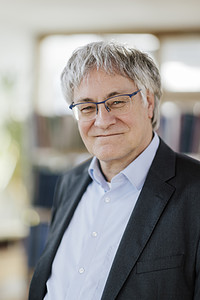
Dr. Uwe Wolf ist als Musikwissenschaftler vor allem im 17. und 18. Jahrhundert zuhause. Seine Arbeitsschwerpunkte reichen von der Zeit Monteverdis und Schütz über Bach und die Generation der Bach-Söhne und -Schüler bis hin zur Wiener Klassik. Seit Oktober 2011 leitet er das Lektorat des Carus-Verlags. Zuvor war er über 20 Jahre in der Bach-Forschung tätig.
High or low?
There is ongoing debate as to whether the movements in “high keys,” Lauda Jerusalem (No. 10) and the two Magnificat settings, should be performed a fourth lower. There are strong arguments against this, which can’t be explored fully in this blog.
For an a cappella performance, it may nevertheless be helpful to perform Lauda Jerusalem in a transposed version, but this would also require men in the two alto parts. If colla parte instruments are introduced, it would be musically more appealing to add them to support the high passages or to have them take over some of these passages on their own, which was quite common practice in the 17th century.
In both settings of the Magnificat, the vocal ranges clearly argue against transposition. Although there are high notes (hence the “high” clefs), when transposed, the sopranos and tenors in particular are in such unfavorable registers that they have to strain to be heard well, even in the historical high pitch, and even more so at a1=440 Hz. The Magnificat should therefore never be transposed for performance.
Leave it out? Always a possibility!
The published form of the Marienvesper follows a programmatic concept, but not a specific performance situation, a service of vespers. The 1610 print offers a kaleidoscope of church music composition after 1600. It can be transformed into a breathtaking concert exactly as it has been handed down. But it is also possible to create something new from its parts: every single piece is magnificent in its own right. A complete performance is just one option.
What versions from Carus can help here?
- Vespers: score (27.801), vocal score (27.801/03), choral score (27.801/05), set pf parts (27.801/19), organ part (27.801/49)
- All choral parts are included in the parts set (27.801/19), which in many cases also offers alternatives for different instruments or keys.
- Transposed version of the Lauda: score (27.801/50), vocal score (27.801/53), choral score (27.801/55), parts set colla parte (27.801/58).
- Magnificat à sei voci: score (27.205), choral score (27.205/05). No colla parte parts are available for this Magnificat, but the choral score can be used to some extent for the short movements, if you want to reinforce the tutti movements or one or other of the cantus firmus.
Madrigali e Motetti. Choral Collection Monteverdi

Monteverdi wrote almost exclusively vocal music. The choral collection is a compilation of 20 compositions: both secular madrigals and sacred motets. In addition, the collection also includes a number of famous madrigals to which one of Monteverdi’s contemporaries added Latin sacred texts soon after their publication.
Missa in illo tempore

Selva morale et spirituale

Today Monteverdi’s Selva morale et spirituale (1641) stands entirely in the shadow of his famous Vespers 1610. The editions from 1610 and 1641 both include music for the Mass and Vespers, but each of these collections was composed under much different circumstances during monteverdi´s lifetime.


Leave a Reply
Want to join the discussion?Feel free to contribute!