
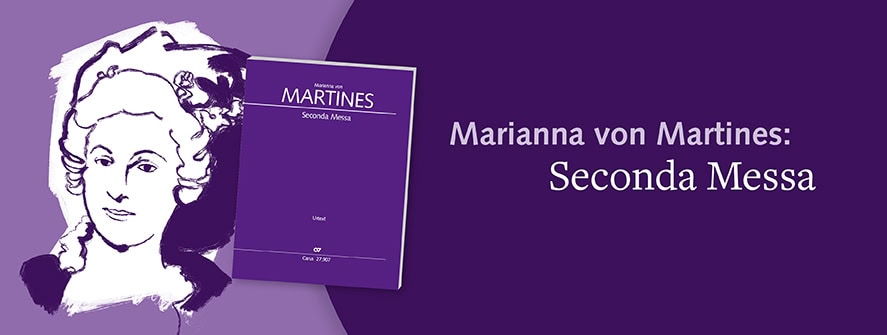
Marianna von Martines
A Fixture in Vienna’s Musical Life
Only in the last few years has Marianna von Martines (1744–1812) finally begun to win the recognition she deserves as an important composer of the eighteenth century. During her life, however, she was a constant presence in the musical life of aristocratic Vienna, and was highly esteemed as a performer and teacher as well as a composer. English music historian Charles Burney praised her singing and keyboard playing in his accounts of his European travels. She may well have performed for Empress Maria Theresa and Emperor Joseph II. Many of her compositions are motets and cantatas for solo voice and keyboard, which she often performed herself.
Her success did not come about by chance: throughout her childhood, young Marianna’s education was directed by her father’s close friend, the celebrated poet and librettist Pietro Metastasio, who lived with the Martines family until his death in 1782. For example, she received piano lessons from the young Joseph Haydn (who had moved into the attic above the Martines family’s apartment after being expelled from the choir at St. Stephen’s Cathedral), as well as singing and composition lessons.
In her later years, Martines composed less, devoting more attention to her highly respected voice studio, and to hosting musical gatherings frequented by some of Vienna’s most prominent musicians.
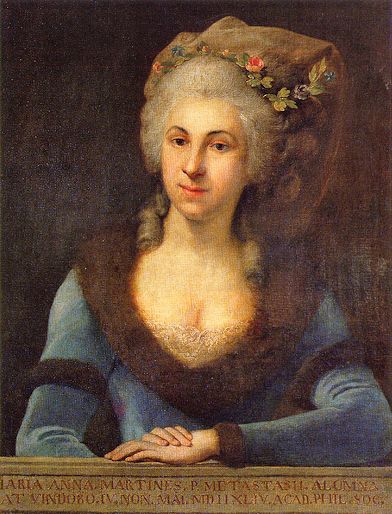
Marianna von Martines
Martines the composer
In addition to cantatas, Martines also composed solo keyboard music, one orchestral symphony, and a number of sacred choral-orchestral works, including four masses and two oratorios. There is no evidence that Martines ever left Vienna, but her compositions won widespread acclaim abroad. Her peak achievement came in 1774, when she became the first woman admitted to the prestigious Accademia Filarmonica of Bologna – whose members included Johann Christian Bach and Wolfgang Amadeus Mozart. This external recognition also led to a signature compositional achievement. The Accademia required all new members to compose a setting of the Dixit Dominus psalm text; Martines’s majestic setting for choir, soloists, and orchestra is now one of her most frequently performed choral works, and is widely considered her masterpiece.
In the course of her application to the Accademia, Martines also left a fascinating portrait of her compositional education and approach. Writing in 1773 to Padre Giovanni Battista Martini at the Accademia, Martines carefully emphasized both her fluency in the latest galant style and her knowledge of the learned techniques of the Baroque.
“My exercise has been, and still is, to combine the continual daily practice of composing with the study and scrutiny of that which has been written by the most celebrated masters such as Hasse, Jomelli, Galluppi, and the others who are famous today and who are praised for their musical labors – and without neglecting the older [generation] such as Handel, Lotti, Caldara, and others.” (Martines to Martini, 16 December 1773.)
Martines’s synthesis and mastery of both old and new styles is a central theme in her works, and scholars studying her music have pointed it out frequently. It is especially evident in her sacred choral-orchestral works, one of the earliest being the Seconda Messa of 1760.
The Seconda Messa
Composed in 1760, when Martines was only sixteen years old, the Seconda Messa is her earliest dated composition, and may well be her earliest surviving work; her “Messe No. I” is undated, and many factors suggest that it was composed later. While her other masses feature large orchestras with oboes and trumpets (and sometimes timpani), the Seconda Messa is largely scored for the common and elegant “church trio” of two violins and continuo. Only in the Benedictus does the scoring expand to include the striking color of two obbligato trombones. Trombones were common in Viennese church music, usually filling out the texture by doubling choral parts. Independent trombone parts are uncommon, though, and lend a dash of individuality to an otherwise traditional scoring.
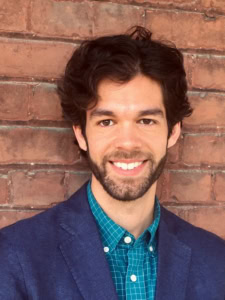
Dr. Joseph Taff is a choral conductor whose scholarship has focused on the works of Marianna von Martines, including an award-winning dissertation on her masses. He is Assistant Professor and Director of Choral Activities at Thomas More University in Crestview Hills, KY, and Director of Music at the Presbyterian Church of Wyoming, OH.
The structure of the mass is also simple and elegant. While Martines’ Terza and Quarta Messe are structured as “cantata masses,” with extended multi-movement settings of the Gloria and Credo, the Seconda Messa sets these two long texts as single movements. The choir’s text declamation is clear and concise, without repetition or telescoping. Solos and duets (like the Christe and Benedictus) have a simple two-part structure, with the first part modulating to the dominant key and the second part returning. On a more local level, Martines frequently employs the stock gestures now known as “galant schemata”, showing off her fluency in the most up-to-date style. At the same time, she makes sure to display her mastery of the stile antico by writing skillful fugues in several traditional spots: the second Kyrie, the closing lines of the Gloria and Credo (“cum Sancto Spiritu” and “et vitam venturi saeculi”), and the repeated Osanna, which concludes both the Sanctus and Benedictus.
There is no evidence that the Seconda Messa was performed during Martines’s lifetime. One of her masses appears to have been performed in 1761 at the Church of St. Michael, which the Martines family attended, but Martines’s biographer Irving Godt is “quite certain […] that the mass sung was her Terza Messa in C,” which she had completed a month earlier. It is not surprising that the young composer would have quickly moved on from the compact Seconda Messa to a more ambitious work such as the Terza, and would have chosen the latter when an opportunity for performance arose. Nevertheless, the Seconda Messa is a gem of Martines’s early style, and deserves to take its place in today’s performance repertoire alongside the charming early works of her better-known contemporaries.
Antonio Caldara: Missa in B
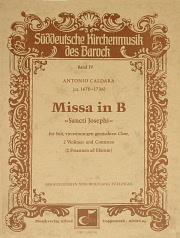
Antonio Caldara probably received his musical training from Giovanni Legrenzi. He worked at the courts of Mantua and Rome, and after moving to Vienna in 1716, he served as first vice-kapellmeister of the Vienna Court Orchestra under Johann Joseph Fux. His musical output is enormous. He composed over 3,400 works, mainly in the field of vocal music, including operas, oratorios, masses, serenades, cantatas, and symphonies.
Johann Ernst Eberlin: Missa brevis in a
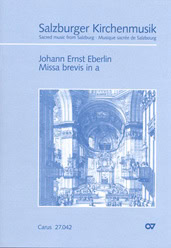
The Missa in A minor clearly reveals the characteristics of the type of Missa brevis developed by Eberlin. The instrumentation is reduced to solos, a four-part choir, and the “Salzburg church trio” with two violins and basso continuo. As a special feature of performance practice in Salzburg Cathedral, three trombones are added, which play colla parte with the alto, tenor, and bass in the choral parts and pause in the solo passages. Eberlin’s distinctive type of Missa brevis provided W. A. Mozart with the model for the formal structure of his masses in this genre.
Johann Michael Haydn: Missa Beatissimae Virginis Mariae
Wolfgang Amadeus Mozart: Missa brevis in G major


Leave a Reply
Want to join the discussion?Feel free to contribute!