
Out to sea
The sailor’s farewell which Fauré set to music in “Les berceaux” speaks to Isabelle Métrope in a very special way.
It is a very emotional moment, which Fauré captures atmospherically in his song “Les berceaux”. The ships leave the harbour, the sailors are separated from their families. The musical depiction of the pain of parting and loneliness, embedded in the incessant sound of the sea, touches Isabelle Métrope very personally, because when she sings the original art song or the choral arrangement by Denis Rouger, she sees the harbour of her childhood before her, from which her grandfather often set out to sea. And she is convinced – even without a personal connection, you will love this atmospheric arrangement!
From the first measures we hear the constant rhythm of the sea in the piano accompaniment. Then the solo voice emerges (in this arrangement it is the sopranos), alone, but singing warmly, as if borne on the waves. It describes how the large ships (and the sailors) gently move in the harbour wind without casting a backwards glance at the lonely women standing ashore, rocking their small children in the same rhythm. In the original piece, after this descriptive section the solo voice has a wider vocal range when the story begins. One day, this image, almost like a still-life, will no longer stand still when the ships leave the harbour. On that day, the men, tempted by adventure, will leave their weeping women behind.
In the version for mixed choir, it is at exactly this point that the music departs from the solo scoring, and as the ships and the men embark on the great ocean, the voices divide. Both the choral singers and the listeners are enveloped in a warm, bigger, and harmonically more exciting sound. And the sea – portrayed here in the piano accompaniment – becomes more animated, richer in sound, and more urgent. And after the end of the choir’s loud, longest phrase, the piano too remains animated and full textured for a few notes longer until the mood changes again, back to one of solitude: on this day, the large ships with their crews leave the harbour, but not entirely unconcerned. They sense how their bodies seem to be restrained by the shore, by an invisible power. This time it is possibly not (only) the women who weep at the separation. The little ones, rocked in the arms of the women, hold back the souls of the men through their presence and their souls alone. As the ships disappear into the distance and this invisible thread becomes thinner and stronger, the five choral parts converge again and disappear at the last note (four voices in unison and just the tenor singing a third quietly) like a dot on the horizon. What remains, ever imperturbable, is the rhythm of the sea.
This beautiful art song by Gabriel Fauré is particularly important to me. My grandfather was a sailor, and my great-grandfather too. How often he was separated from his family for months on end. How often my grandmother herself stood on the harbour with the cradle. When I sing this song, whether as a solo with a friend accompanying on the piano, or as a member of the figure humaine kammerchor, whose conductor Prof. Denis Rouger has so wonderfully arranged it for choir, I have the images of the harbour in my mind’s eye from my childhood. But even without a personal connection to this short story, you will love this piece. Give your choir (and your audience) three minutes of emotions with this arrangement, and rehearse this song. Legato, sound color, enunciating the French vowels – you can happily work on many aspects of vocal technique with your choir with this piece. And if your singers fall under the spell of this repertoire, you can find more French melodies by Fauré, Duparc, Gounod, and others arranged by Denis Rouger for mixed voice choir in the Carus catalog. Of course, taken together, these pieces can make up a concert program of French repertoire, but the themes covered – love, pain, nature – are found throughout music and could easily fit into another program.
Bon voyage…
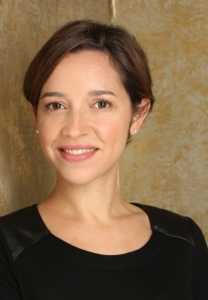
Isabelle Métrope is a singer, choral director, music editor, and translator. She sings in the kammerchor figure humaine, the Kammerchor Stuttgart, and Ensemble Cythera.
Fauré / Rouger: Les Berceaux
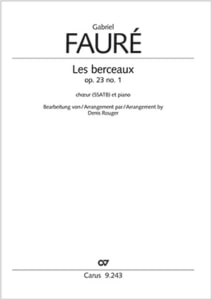 Das Kunstlied wurde ursprünglich nicht für Kammerchor, sondern für eine Solostimme und Klavier geschaffen. Denis Rouger hat es behutsam den Bedürfnissen und Ausdrucksmöglichkeiten eines größeren Ensembles angepasst, ohne dabei die Qualitäten des Originals zu verleugnen.
CD: Kennst du das Land... (figure humaine)
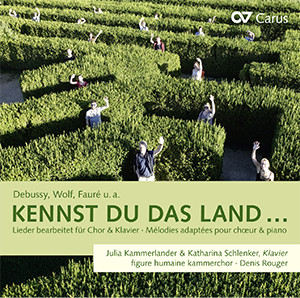 Auf ihrer ersten CD “Kennst du das Land …” präsentiert das Ensemble figure humaine unter der Leitung von Denis Rouger französische sowie deutsche Sololieder in Bearbeitung für Chor.


Leave a Reply
Want to join the discussion?Feel free to contribute!