
“like a shining treasure trove of grandiose melodies, striking orchestral ideas and harmonic turns”
Anne Kohler on Franz Schubert’s Mass in A flat major
50 years of Carus – 50 years of passion for choral music, which we share with you. In the Carus anniversary year, each month in the CARUS blog prominent choral directors present their personal highlight from five centuries of choral music for you.
“Not composed in the style that the Emperor loves” – this was the judgement of the Viennese court Kapellmeister Joseph Eybler, to whom Franz Schubert sent his Mass in A flat in 1826 for performance, albeit to no avail. Schubert himself, who had thoroughly revised the work and added a fugue for the “Cum Sancto Spiritu” (written according to all the rules), was extremely satisfied with the composition and considered it “successful”.
The composition of the Mass took place between November 1819 and September 1822, a creative period when Schubert was simultaneously trying to make a name as an opera composer. Perhaps that is why the Osanna angels in the Sanctus shout with joy to the galopping horn calls in an almost sporty style?
Unusual and surprising, the Mass may have been too expansive and insufficiently subservient to religious worship for the Emperor’s taste. Today, on the other hand, it seems to us to be like a shining treasure trove of grandiose melodies, striking orchestral ideas and harmonic turns, which do not restrict the view of the text of the Mass, but expand it into new dimensions.
Even the sequence of keys for the individual movements (A flat/E/C/F/F minor/A flat) is daring and represents something special because of the relationship to the mediant key. How intimate and cantabile the lines of the low woodwinds sound which open the Kyrie movement and are taken over seamlessly by the strings to prepare the choral entry. The women’s voices sing the Kyrie plea for mercy in simple thirds, answered by bass and tenor, who immediately make it clear through an entry on the seventh that, despite the prevailing classical period, here the spirit of early Romanticism is wafting through the harmonies. The soloists present their Christe invocations with magnificent expansiveness, whilst the choir unfolds and concludes the Kyrie melody in perfect counterpoint.
There are many other brilliant passages to discover in this Mass: for example, the seemingly never-ending Credo interjections break through, full of energy, like a raised forefinger between the individual sections of text of the Creed. And the Sanctus begins with a precious, delicate introduction in F major in a vibrant 12/8 time. However, the choir enters, as a kind of exaggerated vision which works as a deception for a short moment, a semitone higher than expected in F-sharp minor.
Schubert proves himself, with all his richness of ideas, as a master of cantabile part-writing, so that the Mass in A flat major represents a challenging but rewarding work for any choir to perform. High passages are taken at a pace and the few divisi in the vocal parts are written so that they always sound full, even with medium-sized choirs. The Mass is like a garment of the finest fabric that clothes the choir well. It is a shame this was not recognized at the court in Vienna. The Emperor did not want any new clothes …
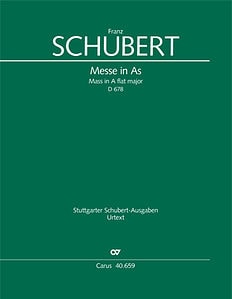
Franz Schubert: Mass in A flat major
Carus 40.659
Anne Kohler is Professor of Choral Conducting at the Hochschule für Musik Detmold. There she conducts the Hochschule Chamber Choir and the jazz vocal ensemble “Pop-Up”, and is responsible for a main study class of choral directors. She has been artistic director of the German Federal Youth Choir since 2020. She has rehearsed choirs including the SWR Vokalensemble and the Berlin Radio Choir for performances with conductors such as Marcus Creed, Pierre Boulez, Roger Norrington, and Ingo Metzmacher. She is busy internationally as director of courses on the topics of choral conducting, vocal training, and jazz choral directing, and as a jury member.
Complete Latin Masses
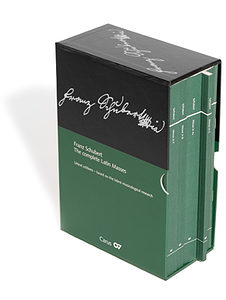 Franz Schubert’s Latin mass settings, together with the masses of Haydn, Mozart and Beethoven, represent a highpoint of the genre and point towards the 19th century in terms of their expressive power.
Mass in A flat: carus music, the Choir Coach
 At home and out and about: Straight away your choral works will always be with you to practice! With carus music, the new choir app, you can follow the music while listening to a top-class recording on your smartphone or tablet, and easily practice your own choral part with the help of a coach.
Mass in G major
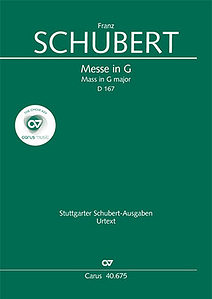 Franz Schubert’s Mass in G major is one of the most popular settings of the mass ordinary: the charming song-like melodic writing, especially in the Kyrie and the Credo, forms a magical counterpoint to more concertante passages in the Gloria and the Sanctus.
Mass in E flat major
 The Mass in E flat major is the last of Schubert’s six settings of the Ordinarium Missae and it is also his most significant work in this form.
De profundis: Hommage an Franz Schubert
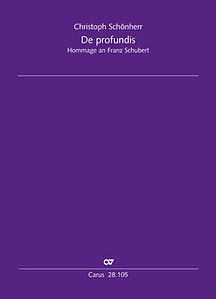 De profundis arose from Christoph Schönherr’s intense study of the last years of Franz Schubert’s life, and refers to the great Romantic with its subtitle of “Hommage”.


Leave a Reply
Want to join the discussion?Feel free to contribute!