
On the Psychology of Simple Country Life
Wolfgang Amadeus Mozart: Bastien and Bastienne
For his first Singspiel in 1768 the twelve-year-old Mozart chose a subject that was both popular and provocative. Bastien und Bastienne is based on Jean-Jacques Rousseau’s one-act pastoral Le devin du village, which he used as a vehicle for his philosophical ideas when he composed it in 1752, at the height of the Querelle des Bouffons controversy about French and Italian operatic styles. Mozart’s nuanced musical portrayal of the three protagonists already hints at the skills he would go on to develop as a psychologically aware opera composer.
Origin and reception
Bastien und Bastienne is Mozart’s first Singspiel and one of his first forays into the realm of opera. Its origins and performance history cannot be reconstructed in any detail. Mozart apparently composed the one-act comedy in the summer of 1768, when he was staying in Vienna with his family. They had arrived in the city in September 1767 to attend the wedding of the Habsburg Archduchess Josepha to Ferdinand IV of Naples, but both Mozart and his sister Nannerl contracted smallpox during an outbreak and did not recover until the end of that year. The family then spent the following year in the imperial capital, with both children performing in concerts and the young Mozart composing, among other works, his first singspiel, his first opera buffa (La finta semplice), symphonies, and the Orphanage Mass (K139) for the consecration of the Vienna Orphanage Church on December 7, 1768, which Mozart himself conducted in the presence of the imperial court.
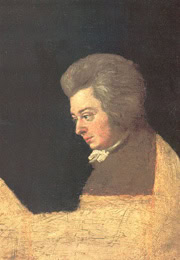
Mozart at the Piano
unfinished painting by
Joseph Lange, 1789
(Mozart Museum Salzburg)
Postcard
Carus 40.390/00
Bastien und Bastienne may well have been performed in October 1768 at the home of Dr. Anton Mesmer, a physician renowned at the time as the pioneer of the theory of magnetism. However no conclusive proof of this presentation survives, nor do we have any definitive evidence of further performances, even though later changes to the text by the Salzburg court trumpeter and occasional poet, Johann Andreas Schachtner, along with new recitatives composed by Mozart, do seem to indicate that one was planned in Salzburg. The earliest verifiable performance of Bastien und Bastienne did not take place until more than a century later, on October 2, 1890, at the Architektenhaus in Berlin.
Plot and libretto
The one-act comedy is set in the countryside and tells the story of Bastien and Bastienne, whose love is thrown into crisis by Bastien’s fickleness. Bastienne laments the loss of her beloved, who is enchanted by the gifts – not so much the charms – of the noble lady from the castle. The wise village soothsayer Colas advises Bastienne to pretend that she has fallen in love with someone else. Her dismissive attitude towards Bastien has the desired effect: he now seeks Colas’ advice, as he does not want to lose Bastienne and is willing to forego the noblewoman’s gold in order to keep her. Colas performs a bizarre magic ceremony for him, supposedly to win Bastienne back, but it terrifies Bastien. After advising Bastien to take better care of his true happiness, Colas then dismisses him. When the remorseful Bastien returns to Bastienne, he at first continues to meet with her defiant rejection, and even his threat to kill himself cannot soften her heart. Only when he swears to love her until death do they reconcile. Colas marries the couple, and the work ends with a song of praise for the wise “magician.”
By setting a French story to music in a German Singspiel, the young Mozart was also familiarizing himself with contemporary French opéra comique. The model for his one-act comedy was Jean-Jacques Rousseau’s one-act play Le devin du village (The Village Soothsayer), composed in 1752 at the height of one of France’s most notorious opera controversies, the Querelle des Bouffons, which saw fierce debate about the relative merits of Italian or French opera. Rousseau aimed to combine both traditions by bringing the natural melodiousness and expressive simplicity of the Italian intermezzo into French opéra comique. His proposal for a simple, folk-like opera, favoring unpretentious (non-courtly) art over “natural artificiality,” turned Le devin du village into a success throughout Europe. A Parisian parody soon followed: Les Amours de Bastien et Bastienne shifted the focus from the village soothsayer to the lovers. In 1764 a German translation of this parody was published in Vienna by Friedrich Wilhelm Weiskern, and it quickly gained widespread popularity. Four years later Mozart’s libretto for Bastien und Bastienne was based on this text.

Jean-Jacques Rousseau
Augustin de Saint-Aubin after
Maurice Quentin de La Tour, 1777
Music
In the spirit of Rousseau’s example, Mozart here composed straightforward, songlike music in simple meters and keys. An idyllic tone pervades the entire piece, sometimes conspicuously embellished with onomatopoeic, pastoral effects such as bagpipe-like ritornellos, pedal points or siciliano rhythms. But these does not reflect any limitations on the part of an inexperienced young composer: on the contrary, a comparison with two arias which briefly evoke emotional worlds beyond the Singspiel clearly indicate that these pastoral stylistic touches were intentional. In Bastien’s aria Meiner Liebsten schöne Wangen (My beloved’s beautiful cheeks), the French style is unmistakeable. It’s marked Tempo di Menuetto, the French court dance par excellence, and scored with two flutes in typical French instrumentation. This aria is preceded by Colas’ “incantation aria,” in strikingly harsh C minor with the hectic accompaniment and accents reminiscent of an aria agitata from Italian opera seria. These deliberate departures from a supposedly simple genre reveal the gifted opera composer Mozart was to become, the one who would later portray his characters in richly differentiated musical psychological studies.
Edition
Mozart’s composition for Vienna was a typical one-act Singspiel, with individual musical numbers and spoken dialogues. He revisited the piece when apparently planning a later performance in Salzburg: his court musician colleague Johann Andreas Schachtner changed the text in some places, and Mozart began to compose secco recitatives to replace the dialogues (three of which have survived). He wrote these recitatives for the part of Colas in alto clef (instead of bass clef), thus envisaging a different vocal range for them. Earlier editions however mixed the original Viennese version with the later revision of the work. Ulrich Leisinger’s edition clearly separates the two for the first time: the new recitatives appear in the appendix, and Schachtner’s individual text changes are highlighted in italics in the main score. This makes it possible to perform either Mozart’s Vienna version or the Salzburg adaptation.

Dr. Henning Bey has been working as Promotion Manager for Stage and Orchestra at Carus-Verlag since October 2025. Previously, he served as Artistic Planner with the SWR Symphony Orchestra, Chief Dramaturge of the International Bach Academy Stuttgart, and Dramaturge at the Freiburg Baroque Orchestra. He gained editorial experience as a member of the editorial team of the New Mozart Edition in Salzburg.
Hasse: Cleofide
Hasse's Cleofide of 1731 can be regarded as the zenith of his creative output – not least of all because he integrated several of his greatest arias from earlier works into this opera. The theme from antiquity "Alexander's conquests in India" was perfectly suited to flatter August the Strong, a rather unsuccessful commander-in-chief, who at that moment was occupied with the reorganization of his armies. For performance at the Court of Dresden, Metastasio's original libretto was reworked by Michelangelo Boccardi.
Mozart: Der Schauspieldirektor (The Impresario)
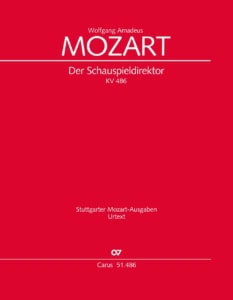
In 1786, Mozart took part in an opera contest ordered by the Emperor, competing against court kapellmeister Antonio Salieri: Italian opera buffa versus German Singspiel. Within just fourteen days, Mozart composed Der Schauspieldirektor, a satire on the eccentricities and vanities of the theatrical world.
Hasse: Marc’Antonio e Cleopatra
With this early work, which Hasse composed while a student of Alessandro Scarlatti’s and still heavily under his influence, and which was performed at the country estate of the royal advisor Carlo Carmignano in September 1725, Hasse was able to draw attention to himself as a composer for the first time publicly. The libretto stems from Francesco Ricciardi; the famous singers Vittoria Tesi and Carlo Broschi (Farinello) sang the two main roles.







Leave a Reply
Want to join the discussion?Feel free to contribute!