

World History in a Chamber Drama
Johann Adolph Hasse: Marc’Antonio e Cleopatra
The serenata Marc’Antonio e Cleopatra is a small-scale opera seria. Composed in Naples in 1725 for a private patron and premiered in his villa with the famous vocal virtuosi Vittoria Tesi and Farinelli, it was the first operatic composition of the young Hasse to attract considerable attention and marked the beginning of his career as one of the most celebrated opera composers of the 18th century.
Origin and reception
In 1722 the twenty-three-year-old Johann Adolph Hasse arrived in Naples, where he initially studied composition with Alessandro Scarlatti. Prior to this, he had worked mainly as a singer and only occasionally as a composer at the court of Brunswick, until his employer sent him on a study trip to Italy, which ultimately took him to Naples via Venice, Bologna, Florence and Rome. In 1725 the royal advisor Carlo Carmignano commissioned Hasse to compose a serenata for a performance at his country house just outside the city. The extremely successful private premiere of Marc’Antonio e Cleopatra, featuring two prominent singers before an educated and distinguished circle of influential figures, served to make Hasse famous overnight and in great demand.
Johann Joachim Quantz, who was later to become Frederick the Great’s flutist, met Hasse in Naples during this period. He recalled in 1755, “Farinello and Tesi sang in it. Through this serenata Mr. Hasse gained so much acclaim that he was immediately entrusted with composing the music for the opera to be performed at the royal theater in May of that year. And this opera paved the way for his future success.” Marc’Antonio e Cleopatra is, in a sense, Hasse’s journeyman piece as an opera composer. Over the next five years he wrote for the stages of Naples alone the impressive number of seven opere serie, one opera buffa, three serenatas, and about eight intermezzi. By the time he set off for Dresden in 1731 to take up his new position as Kapellmeister of the Royal Polish and Saxon Electoral Court, he was a European celebrity, sought after by all opera houses and affectionately known everywhere as il Sassone, presumably in reference to his Lower Saxony origins.
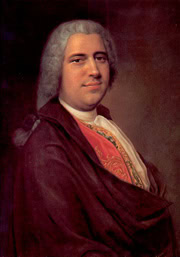
Johann Adolf Hasse
Balthasar Denner, 1740
Postcard
Carus 40.369/10
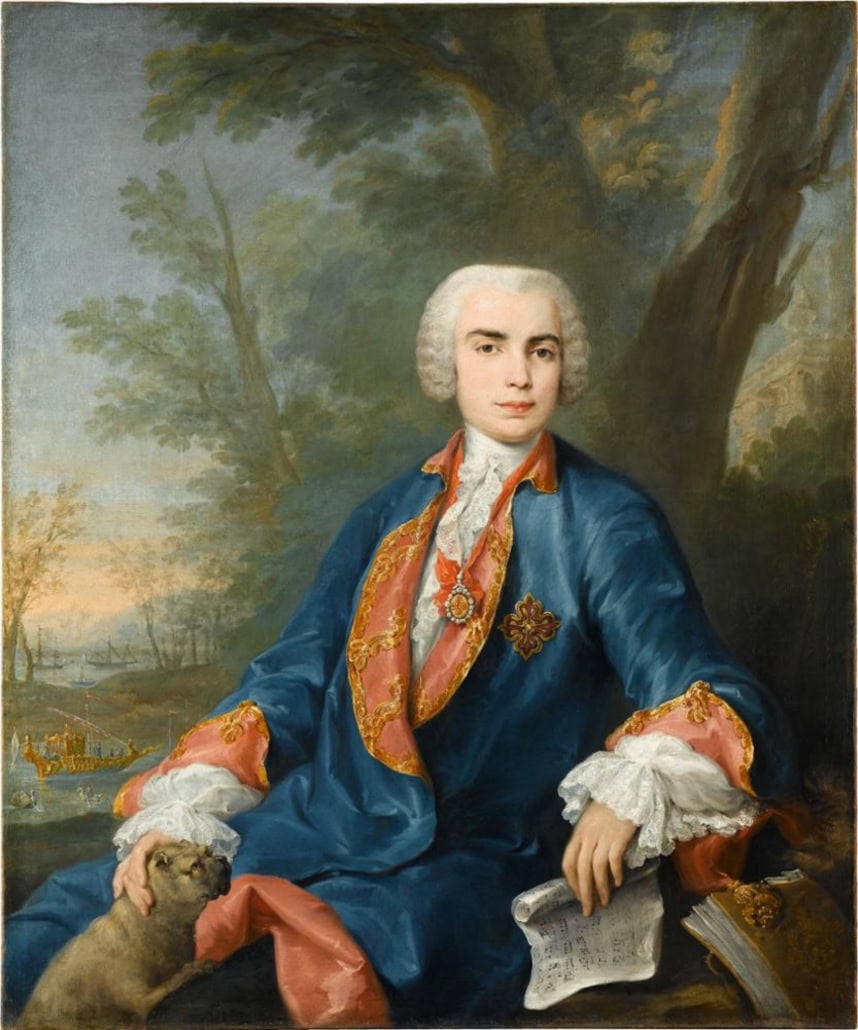
Portrait of the soprano castrato Carlo Broschi (Il Farinelli),
Jacopo Amigoni, ca. 1752
Plot and libretto
Hasse’s serenata is set in the aftermath of the Battle of Actium in 31 BC. The forces of the victorious Octavian (later Augustus) have comprehensively defeated the army of Marcus Antonius, and all of Egypt is now in Roman hands. Against this political backdrop Hasse tells the private story of two lovers: the general Marcus Antonius and Cleopatra, the legendary queen of Egypt. Both have fled at the end of the battle, Marcus to be with his beloved as quickly as possible, and Cleopatra to avoid being taken to Rome as a prisoner. Together they reminisce about their early days as a couple, when they came together not as ruler and military leader, but simply as lovers. While Marcus briefly considers making another attempt to fight their common cause with fresh troops, Cleopatra is certain that her end is near. She wants to die on her own terms and in freedom; Marcus Antonius wishes to be united with her in death. Thus they choose to commit suicide together, their last thoughts turning to a golden future for the “Holy Roman Empire of the German Nation” under Emperor Charles VI and Empress Elisabeth Christine, the reigning couple in Hasse’s own time.

The librettist of Marc’Antonio e Cleopatra is known to have been Francesco Ricciardi, who was active in Naples at the time as both impresario and poet. (The following year he also wrote the libretto for Hasse’s serenata La Semele, o sia La richiesta fatale.) Although Alessandro Scarlatti had already composed a chamber cantata for soprano, alto and basso continuo in 1707, based on the story of Marcus Antonio and Cleopatra and rejoicing in the same title, Ricciardi and Hasse succeeded in creating a work that was independent of it. Ricciardi’s text is dramatic in expression and garnished with several allusions to classical Italian literature.
In the 18th century a serenata was usually performed to celebrate an event or to pay homage to a public figure. Marc’Antonio e Cleopatra also fulfills this expectation, with a leap in time (somewhat surprising to us today) from antiquity to the contemporary world of the 1730s: in their final recitatives and in their joint closing duet, Marcus Antonius and Cleopatra sing the praises of the reigning imperial couple.
Music
Hasse’s serenata is a condensed opera seria: composed in the same style, with the same sequence of recitatives and arias, but significantly shorter at around ninety minutes, with only two singers, no chorus, and accompaniment consisting only of strings with basso continuo. The work is in two parts, each comprising four arias and a concluding duet; the individual numbers are introduced and linked by recitatives. Two of the most famous singers of their time, Vittoria Tesi as Marc’Antonio and Carlo Broschi (the future Farinelli) as Cleopatra, sang in the premiere. It was quite normal in this period for a woman to sing a male role and a man to sing a female role, as the gender of the performers was generally of little relevance in baroque opera casts.
With these two outstanding voices as his models, Hasse set high standards for the singers. Quantz wrote of Vittoria Tesi, “The range of her voice was extraordinarily wide. Singing high or low presented no difficulty for her.” The young Farinelli was to become famous for his long melodic lines and his expressive, seemingly endless messa di voce.
The entire dramatic power of the piece therefore depends on the singers’ interpretive abilities, both in the improvised embellishments in the arias as well as in the rhetorical shaping of the recitatives, whose emotional intensity increases as the plot progresses, supported by the addition of more instruments. Hasse’s musical chamber drama is perfectly designed for an entertaining evening, with two expressive vocal parts, a small, flexible ensemble, and ample space for the performers to bring their own interpretation and artistry to the work.

Dr. Henning Bey has been working as Promotion Manager for Stage and Orchestra at Carus-Verlag since October 2025. Previously, he served as Artistic Planner with the SWR Symphony Orchestra, Chief Dramaturge of the International Bach Academy Stuttgart, and Dramaturge at the Freiburg Baroque Orchestra. He gained editorial experience as a member of the editorial team of the New Mozart Edition in Salzburg.
Hasse: Cleofide

Hasse’s Cleofide of 1731 can be regarded as the zenith of his creative output – not least of all because he integrated several of his greatest arias from earlier works into this opera. The theme from antiquity “Alexander’s conquests in India” was perfectly suited to flatter August the Strong, a rather unsuccessful commander-in-chief, who at that moment was occupied with the reorganization of his armies. For performance at the Court of Dresden, Metastasio’s original libretto was reworked by Michelangelo Boccardi.
Mozart: Der Schauspieldirektor (The Impresario)
 Der Schauspieldirektor (The Impresario) was composed in the spring of 1786 to fulfill a commission from Joseph II for performance during a visit to Vienna by the Governor-General of the Netherlands. The visitors were meant to be entertained with a short German and an Italian musical comedy during a festival arranged on short notice in Schönbrunn Palace. The choice of composers fell to Mozart and Salieri. Both pieces spoofed the theatrical practices of the day.
Mozart: Bastien und Bastienne

The story of Bastien und Bastienne is based on the musical pastoral “Le Devin du Village” by Jean-Jacques Rousseau. The play was hugely popular in paraphrase and translation and entered the repertoires of travelling companies and children’s theaters. A shepherd succumbs to the enticements of the lady of the castle and tries to abandon his beloved. The village soothsayer appeals to his conscience and advises the abandoned Bastienne to feign coyness until Bastien shamefacedly returns to her.







Leave a Reply
Want to join the discussion?Feel free to contribute!