
An operatic thriller with vocal pyrotechnics
Giacomo Puccini: Tosca
Giacomo Puccini’s Tosca is one of the most beloved and frequently performed of all operas. It features some of the most moving arias and ensemble scenes ever written, while the exciting love story of two artists set against a backdrop of political turmoil (complete with a quintessential villain) guarantees a timeless relevance. Carus is presenting a new critical edition of the work aimed at restoring Puccini’s original artistic vision, in particular his intentions regarding dynamics and orchestral transparency.
Plot
The action unfolds in Rome on 17 and 18 June 1800, at a time when the city is under Neapolitan rule and supporters of the recently overthrown Roman Republic are being persecuted. At the center of the plot are the church painter Mario Cavaradossi, a supporter of the Republic; his lover Tosca, a celebrated singer tormented by jealousy; the escaped political prisoner Angelotti, former consul of the Roman Republic established by Napoleon; and the ruthless, brutal chief of police, Scarpia. Cavaradossi helps Angelotti escape. Scarpia discovers Cavaradossi’s involvement, interrogates him, and has him tortured in order to learn Angelotti’s whereabouts. In the end, Tosca reveals the hiding place to save her lover from further torture. Scarpia has Mario condemned to death, but then offers Tosca a devilish bargain: if she gives herself to him, Mario will live. Tosca agrees. Once Scarpia has given her a safe-conduct and promised a mock execution, she seizes a knife and stabs him to death. In the highly dramatic finale at the Castel Sant’Angelo, Tosca and Mario are reunited. She explains the plan for the staged execution and their subsequent escape together. Scarpia, however, has deceived her: the bullets are real, and Mario is killed. When the murder of the chief of police is discovered and soldiers try to arrest Tosca, she throws herself from the battlements. The opera thus ends in catastrophe, with several deaths.
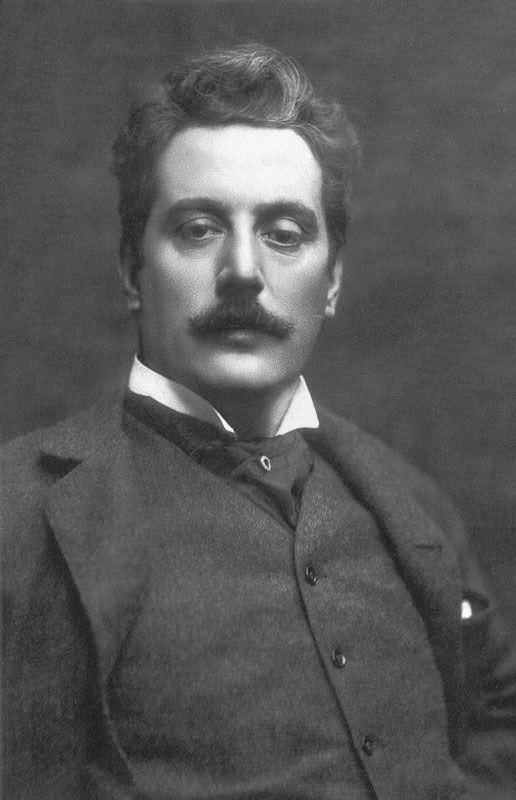
Giacomo Puccini
1858 – 1924
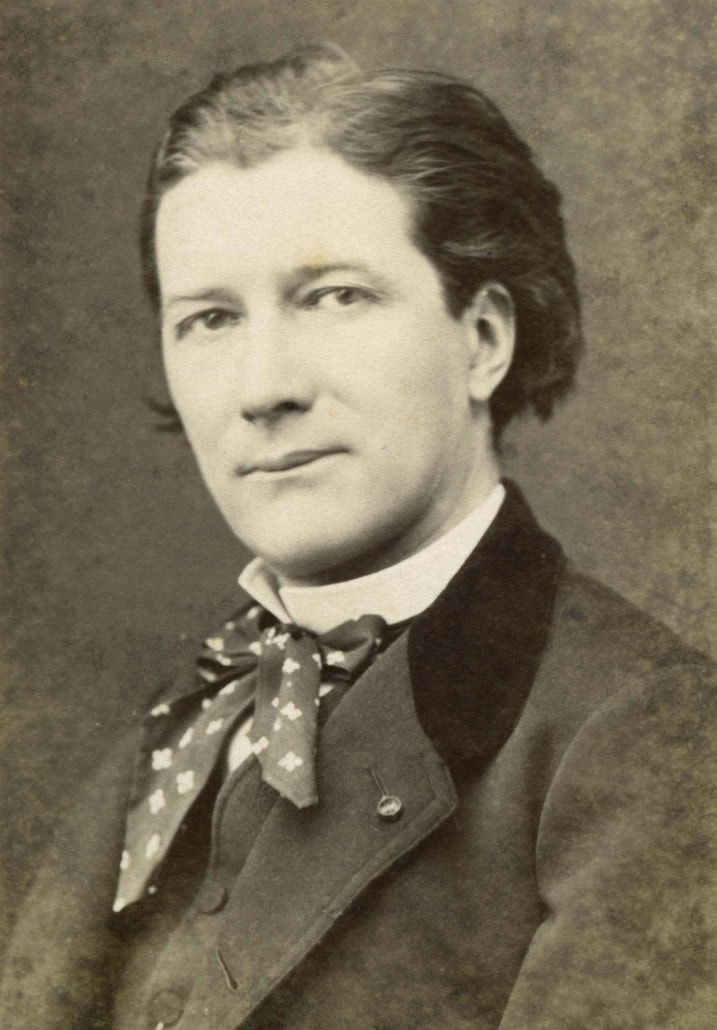
Victorien Sardou
Author of the play Tosca
1831 – 1908
Libretto and structure
Victorien Sardou’s five-act play of the same name served as the literary source for Puccini’s three-act opera. Sardou wrote the piece in 1887 for the famous actress Sarah Bernhardt, tailoring the role of Tosca perfectly for this larger-than-life diva. Luigi Illica and Giuseppe Giacosa—who had previously written the libretto for La Bohème and would collaborate with Puccini a few years later on Madama Butterfly — adapted the play into an opera libretto. With a celebrated singer as its heroine, Tosca is a classic “prima donna opera.” Like Francesco Cilea’s Adriana Lecouvreur, which premiered two years later, it explores diametrically opposed spheres of life whose collision leads to conflict and tragedy: art versus reality, an aesthetic lifestyle versus political intrigue and power dynamics.
In such an environment, art and artists cannot exist in a vacuum, removed from political and social realities. We see this in the figures of both Tosca and Cavaradossi, though their perspectives are vastly different. While he, readily accepting the conflict between art and reality, takes a clear stance, she is violently ripped from her sheltered life as a diva, forced into actions that lie far outside her comfort zone. Puccini’s opera is groundbreaking in its stark, often shocking portrayal of passion and brutality (torture, murder, sexual harassment)—elements that had previously only been implied in Italian opera, taking place in the minds of the audience rather than directly portrayed on stage. The three acts are similarly structured, each featuring a contemplative moment of reflection within the action (the arias of Cavaradossi and Tosca) before building to a dramatic climax. Act I closes with the massive choral Te Deum, over which Scarpia sings his devilish “credo.” Act II concludes with Scarpia’s murder, and the opera’s final scene in Act III culminates in Cavaradossi’s “mock mock execution” (Uwe Schweikert) and Tosca’s suicide.
Origins, reception, and impact
Although Tosca is chronologically the fifth opera in his oeuvre, Puccini had already considered its story and planned a setting around the time of his second opera, Edgar. When Sardou’s five-act play premiered in Milan and Turin in February and March of 1889 starring Sarah Bernhardt, an utterly enthralled Puccini was sitting in the audience. Shortly after, the composer had his publisher, Ricordi, secure the rights before returning to work on La Bohème. In July 1896, just a few months after La Bohème’s premiere, Puccini began working on Tosca—a project that would occupy him for the next three years.
The initial phase was marked by extensive dramaturgical preparation. Working as a trio, Puccini, Luigi Illica, and Giuseppe Giacosa developed the piece: Illica drafted the individual scenes, action, and dialogue, while Giacosa transformed these outlines into musical and emotional poetry tailored to Puccini’s personal style. Puccini traveled to Paris to consult with Sardou on adapting his play into an opera libretto. A central point of debate was the ending: In the first version of the libretto, Puccini wanted Tosca to go mad rather than commit suicide, but Sardou insisted (and ultimately prevailed) on her desperate leap from the Castel Sant’Angelo.
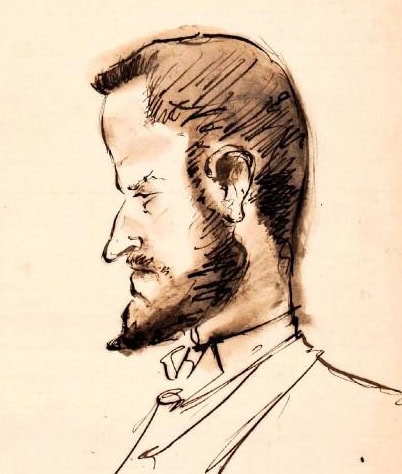
Leopoldo Mugnone
Conductor of the premiere
1858 – 1941
Sketch from 1896
Alongside dramaturgical preparation came meticulous research for the background music in each act to create a realistic atmosphere. For the Act I finale, a priest friend of Puccini’s gave him the exact text of the Te Deum sung in Rome, along with details of the precise pitch of the bell at St. Peter’s and the sound of Roman church bells (for the opening of Act III). Together with Leopoldo Mugnone, who conducted the premiere, he even visited bell foundries in search of instruments that could replicate the authentic sound of Rome’s churches.
Act III proved the most time-consuming for Puccini, who labored long over the duet between Mario and Tosca. Simultaneously, early rehearsals with the soloists began at his villa in Torre del Lago, with Mugnone taking part. The opera received its world premiere on 14 January 1900 at Rome’s Teatro Costanzi, the city where the story itself unfolds. With Tosca, Giacomo Puccini presented an operatic concept that demanded a new kind of musical setting. This explains the sharp initial criticism from contemporaries. Its kaleidoscopic plot leaps masterfully between love, jealousy, sadism, art, politics, and religion. Mirroring this complex, contrast-rich narrative, Puccini’s score is volatile, fragmented, and disparate. Long, sweeping melodic lines in the traditional Italian operatic style are rare in this dynamic work. Yet when they do appear, their impact is all the more powerful.
After the premiere, a further 19 performances took place in Rome, followed by productions in Turin, Milan, Verona and Genoa. Surprisingly, Tosca was not an immediate triumph. Its storyline—which today would be likened to a fast-paced thriller—struck some contemporaries as too drastically brutal and unsuited to opera. Act II, in particular, where the drama unfolds at a breakneck pace, received a rather cool reception from the Roman audience on opening night. It was not until two months later, when the opera opened at La Scala in Milan under Arturo Toscanini, that Tosca achieved its breakthrough and became a resounding success. Major international houses took notice, leading to performances in Buenos Aires, London, New York (1901), Dresden (1902), and Paris (1903).
The music
Puccini’s music achieves a thrilling balance between raw naturalism and lyrical beauty. Central to this is the use of musical motifs which permeate the entire work (such as the three harsh opening chords representing the chief of police, Scarpia). The mood of a scene can shift in a single bar, haunting melodies are interrupted by violent orchestral outbursts, and entirely different emotional planes transition directly into one another. This gives the narrative an intense momentum and creates an extreme dramatic pull. Essential components of this high-tension drama include a multi-dimensional orchestral score composed of numerous rhythmic and melodic particles, alongside vocal parts that alternate between singing, speaking and—at times—even screaming. Music and text are inextricably linked, and it is typical of Puccini that his orchestral score does not merely illustrate the action but becomes the drama itself. In each of the three acts, Puccini writes offstage music that lends the accompanying action a heightened sense of realism.
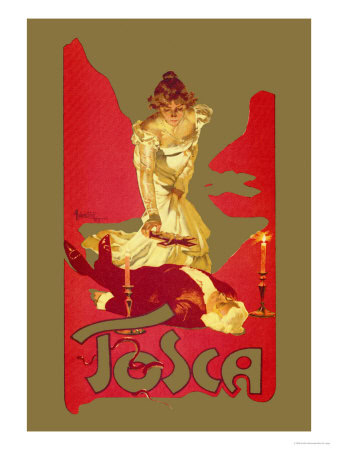
Original poster by Adolfo Hohenstein
for the premiere of Tosca
With unerring theatrical sense, he places these offstage pieces at pivotal moments in the plot: At the end of Act I, a powerful Te Deum sung by the chorus represents the crowd celebrating the (supposed) victory over Napoleon. Simultaneously, Scarpia sings on stage of his sinister plans for Cavaradossi and Tosca: “One to the gallows, the other in my arms…” The scene culminates in his cry, “Tosca, you make me forget God!” just as the chorus sings “Te Deum laudamus! Te Dominum confitemur!” Puccini crafts a similarly striking contrast at the start of Act II: Scarpia dines alone, awaiting Angelotti’s arrest, as orchestral music drifts in through the window. Shortly after, Cavaradossi is brought before him, and the opening of a cantata is heard offstage—first with chorus, then featuring Tosca’s solo voice—triggering an immediate emotional reaction from both men. Scarpia’s questioning of Cavaradossi grows increasingly tense and menacing. Now the stakes become existential: the interrogation grows increasingly confrontational, with everything driving towards the painter’s torture. Through a sequence of instrumental music—chorus and orchestra, solo voice (Tosca), chorus and orchestra offstage (running in parallel to Cavaradossi’s interrogation)—Puccini ratchets up the tension. Suddenly, the spell is broken: Scarpia slams the window shut and the music breaks off. The pent-up drama now discharges into Cavaradossi’s torture (only to build anew until Tosca’s betrayal of Angelotti’s hiding place). Act III opens with the distant song of a shepherd boy, setting a reflective tone for a star-filled night. This is clearly intended as a deliberate pause in the action, briefly halting the dramatic momentum after the devastating finale to Act II. At the same time, the shepherd’s song subtly foreshadows Cavaradossi’s yearning farewell aria (“E lucevan le stelle”) and the ultimate tragedy, as the unknown singer declares: “I’m brokenhearted. Golden light of dawn, you make me die!”
Puccini composed three of his most famous arias for Tosca, each acting as a tranquil “eye of the storm” within the high-voltage narrative: Cavaradossi’s “Recondita armonia,” heard early in Act I, is a heartfelt declaration of love for Tosca, comparing her to the blonde, blue-eyed image of Mary Magdalene he is painting. Even as Tosca’s fatal jealousy already rears its head (a weakness Scarpia will later exploit), time stands still for a brief moment in this aria. But it is just a pause before the individual plot lines are set ruthlessly in motion. In Act II, Tosca’s “Vissi d’arte” temporarily shuts out the brutal actions taking place on stage. Cavaradossi’s torture, Scarpia’s carnal desires and his blackmail of Tosca all recede into the background as the heroine momentarily detaches herself from the drama in a heartbreaking prayer: “Lord, why do you repay me thus?” Here too, after this lyrical interregnum, the subsequent events appear all the more violent. “E lucevan le stelle,” Cavaradossi’s great Act III aria (and one of Puccini’s most celebrated inspirations), brings us full circle back to his first-act aria: still an all-surpassing declaration of love for Tosca, the music is now steeped in farewell, melancholy and the premonition of death. Here again, “reality” recedes into the background, and the operatic drama pauses briefly before the ultimate denouement.
About the Edition
In this new Carus critical edition of Tosca, editor Andreas Gies set out to resurrect Puccini’s authentic orchestral palette, in particular aiming to reinstate the dynamic nuanced range and transparency of texture originally envisioned by the composer. It is based on the final full score published during Puccini’s lifetime in 1924, which remains the standard performative version today, and yet contains numerous additions and the smoothing out of articulation and dynamics that took root over early performance traditions rather than originating from the composer himself. Drawing on comprehensive source comparisons, the musicologist and opera conductor Gies has restored the detailed original readings that were central to Puccini’s vision. In many instances, he returned to the autograph manuscript, which clearly reflects the composer’s true intentions. For the first time, this edition offers a thoroughly consistent presentation of Tosca’s dynamic and articulatory complexity. Gies brings back subtleties that seemed long lost, allowing individual orchestral effects to be heard anew.
At the same time, the Carus edition is tailored directly to the practical needs of performers. The orchestral material impresses at first glance with its clear layout and carefully planned page turns. Furthermore, the orchestral parts feature cue notes from the solo passages (often on an additional staff in the string parts) to aid orientation and ensure seamless coordination between the pit and the stage.
In addition to the full score, orchestral parts, and vocal score, Carus is offering a director’s book (formatted for both right- and left-handed directors), a rehearsal scenario, and the libretto as an HTML file.

Dr. Henning Bey has been working as Promotion Manager for Stage and Orchestra at Carus-Verlag since October 2025. Previously, he served as Artistic Planner with the SWR Symphony Orchestra, Chief Dramaturge of the International Bach Academy Stuttgart, and Dramaturge at the Freiburg Baroque Orchestra. He gained editorial experience as a member of the editorial team of the New Mozart Edition in Salzburg.
Mozart: Der Schauspieldirektor (The Impresario)
Der Schauspieldirektor (The Impresario) was composed in the spring of 1786 to fulfill a commission from Joseph II for performance during a visit to Vienna by the Governor-General of the Netherlands. The visitors were meant to be entertained with a short German and an Italian musical comedy during a festival arranged on short notice in Schönbrunn Palace. The choice of composers fell to Mozart and Salieri. Both pieces spoofed the theatrical practices of the day. Der Schauspieldirektor, by Gottlieb Stephanie the Younger, has a loosely-constructed plot that hinges on the vanity of opera singers and the empty-headedness of many traveling companies.
Mozart: The Magic Flute (Arrangement for chamber orchestra)
This version is particularly suitable for smaller ensembles, university orchestras, and concert performances with limited space. In addition to the full score, a vocal score, orchestral parts, and choral score are also available.
Hasse: Cleofide
Hasse’s Cleofide of 1731 can be regarded as the zenith of his creative output – not least of all because he integrated several of his greatest arias from earlier works into this opera. The theme from antiquity “Alexander’s conquests in India” was perfectly suited to flatter August the Strong, a rather unsuccessful commander-in-chief, who at that moment was occupied with the reorganization of his armies. For performance at the Court of Dresden, Metastasio’s original libretto was reworked by Michelangelo Boccardi.
Mozart: Bastien and Bastienne

The story of Bastien und Bastienne is based on the musical pastoral “Le Devin du Village” by Jean-Jacques Rousseau. The play was hugely popular in paraphrase and translation and entered the repertoires of travelling companies and children’s theaters. A shepherd succumbs to the enticements of the lady of the castle and tries to abandon his beloved. The village soothsayer appeals to his conscience and advises the abandoned Bastienne to feign coyness until Bastien shamefacedly returns to her.
Hasse: Marc’Antonio e Cleopatra
 With this early work, which Hasse composed while a student of Alessandro Scarlatti’s and still heavily under his influence, and which was performed at the country estate of the royal advisor Carlo Carmignano in September 1725, Hasse was able to draw attention to himself as a composer for the first time publicly. The libretto stems from Francesco Ricciardi; the famous singers Vittoria Tesi and Carlo Broschi (Farinello) sang the two main roles. Hasse’s intimate musical drama is perfectly suited for an entertaining evening, with two expressive vocal parts, a small, flexible ensemble, and ample room for the performers to add their own creative touches.


Leave a Reply
Want to join the discussion?Feel free to contribute!