
Utter dedication to Giacomo Puccini
At the Centro Studi Giacomo Puccini in Lucca
A bona fide classic in the Carus catalog is the Messa a 4 voci con orchestra by Giacomo Puccini – also known as the Messa di Gloria. The work was also the first volume in the critical edition of Giacomo Puccini’s works published by Carus from 2012, which has been recognized by the Italian Ministry of Culture as an Edizione Nazionale. Four volumes have been issued so far. The next-featuring Composizioni per pianoforte – will be available from the spring. It invites pianists to explore a little-known facet of the famous opera composer Puccini. The Edizione Nazionale delle Opere di Giacomo Puccini is edited by the international research institute Centro Studi Giacomo Puccini in Lucca. Its many scholars work with endless dedication and great determination to preserve “their” Puccini. Possiamo presentarvi?
Opera fans will be familiar with the beautiful Tuscan city of Lucca as the hometown of composer Giacomo Puccini, who was born there on December 22, 1858. Growing up with six sisters and one brother in a family of musicians, he received his first music lessons from his father at a young age. After Puccini senior’s early death in 1864, various relatives and students of the father continued the musical education. The Puccinis had been musicians in Lucca for four generations, and the young Giacomo seemed destined for a career as a church musician. And, in the early 1870s, he did in fact regularly work as an organist in various local churches in Lucca. It was during this period that he composed his Messa a 4 voci, which is still popular with choirs all over the world. In 1876, however, after seeing a performance of Verdi’s Aida in Pisa, Puccini decided to turn his back on sacred music and instead forge a career in opera. In 1880, he went to study in Milan, where he soon made a name for himself as a composer of symphonies and operas. Yet he never forgot the particular quality, energy and freshness of the Messa. The musical quotations from this work which he incorporated in later operas ensured the Mass’s great popularity after its rediscovery in 1952.
Lucca still celebrates its famous son today. The building where Puccini was born remained in the family for many years before it finally came into the possession of the Puccini Foundation in 1974. Today it houses a museum dedicated to the composer, and thus is number one on the list of Lucca’s attractions for Puccini fans from around the world. Also worth a visit is the nearby Villa Puccini in Torre del Lago, where Puccini spent many years from 1891 and composed many of his operas. The Centro Studi Giacomo Puccini, on the other hand, is located in Lucca in the Casermetta San Colombano, built on the city ramparts, which can be traced back to the mid-16th/17th century. Here the Centro has offices, a library and a conference room. Since 1996, the Centro has been an independent, non-profit cultural center instituted as an association. It has set itself the goal of bringing together the leading experts and devotees of Giacomo Puccini and his work in his hometown to establish a hub for interested scholars and musicians.
The Centro is inextricably linked with the name of Gabriella Biagi Ravenni, who has been the center’s President since 2007. In 1996 she founded the Centro together with Julian Budden, Gabriele Dotto, Michele Girardi, Arthur Groos and Maurizio Pera. In the years since, diverse research projects have been launched, documents compiled (the collection now includes over 10,000 analog and digital reproductions) and a specialist library of over 4,000 items set up, which is now integrated into Italy’s national library system. The Centro also organizes congresses, conferences and exhibitions. It publishes continuously and comprehensively on Puccini and his work, e.g. conference reports, essays and the journal Studi pucciniani. In addition to volumes of printed music (Carus), the Edizione Nazionale also publishes an edition of all of Puccini’s surviving letters (Olschki) as well as several volumes of historical staging notes (EDT), some of which feature contributions by Puccini himself.
In this way, the Centro functions as an international hub for a wide range of activities related to the composer, whether research, the dissemination of findings or advice to organizers on how to realize successful performances of Puccini’s work. It has also been fundamental to the comprehensive reassessment of Giacomo Puccini’s oeuvre. For example, his organ works, which lay neglected for many years, have now been carefully edited and published as one volume of the Edizione Nazionale (ENOGP, 11/2.1). Many of these previously unknown pieces were discovered by musicologists at the Centro in the estate of Puccini’s granddaughter Simonetta Puccini, who died at the end of 2017. Even 100 years after Puccini’s death, the Centro Studi Giacomo Puccini still has a lot of valuable work to do.
Giacomo Puccini: Messa a 4 voci con orchestra
Edizione Nazionale delle Opere di Giacomo Puccini, III/2
SC 6
Carus 56.001/00
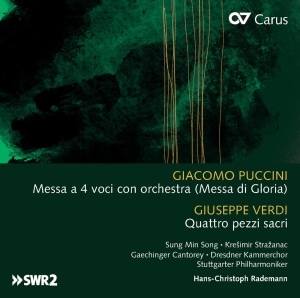
Puccini: Messa a 4 voci con orchestra (Messa di Gloria) & Verdi: Quattro pezzi sacri
Under the baton of Hans-Christoph Rademann, performed by the Gaechinger Cantorey, the Dresdner Kammerchor, the Stuttgarter Philharmoniker as well as Sung Min Song and Krešimir Stražanac.
Carus 83.535/00
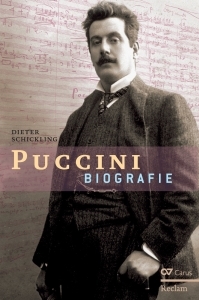
Dieter Schickling: Giacomo Puccini
THE Puccini biography par excellence by Puccini expert Dieter Schickling (only in German)
Carus 24.126/00

Messia di Gloria arrangement for chamber orchestra (arr. J. Linckelmann)
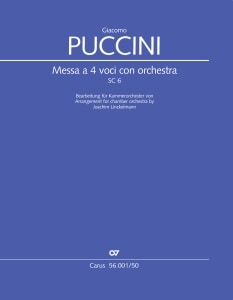
How often do choir directors want to perform the famous Messa di Gloria, but do not have a large enough ensemble at hand? This arrangement for chamber orchestra (flute, oboe, clarinet, horn, bassoon, timpani and strings) solves the problem: smaller ensembles are also given the opportunity to perform this work without the choir being dominated by a large symphony orchestra. The symphonic character of the work is nevertheless preserved. This scoring offers an optimal balance between transparency and orchestral sound.
Requiem aeternam
An impressive oeuvre easily achievable: Puccini wrote the short Requiem – actually the setting of the antiphon to the Introit of the Mass for the Dead – as a commission for the publisher Giulio Ricordi for the fourth anniversary of the death of Giuseppe Verdi, which occurred on 27 January 1905.
Today the work is often performed, since this setting for three voices can be easily performed by amateur choirs and requires only a viola and a harmonium (or organ) as accompanying instruments.
Sonate, Versetti, Marce. Selected Organ Works
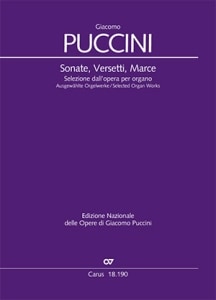
It’s a first! Now that the manuscripts of the organ sonatas have resurfaced, it has finally become possible to form an acquaintance with the major part of Giacomo Puccini’s early compositions in Lucca, which until now were known only from anecdotes.
The present selection with 12 works sheds light on this segment of his oeuvre.


 (c) Sven Cichowicz
Leave a Reply
Want to join the discussion?Feel free to contribute!