

Fragility and Intimacy
Walter Väth’s first encounter with Max Reger was on the organ with his choral fantasies. In the first place he found Reger’s music to be bombastic and difficult, weighty and expressive, but not necessarily simple. But this assessment changed when Väth came into contact with Reger’s later works, These later works also include the Acht geistliche Gesänge op. 138, which schow a simpler Reger …
I had my first encounter with Max Reger on the organ, with his expansive chorale fanatasies and at first I found his music bombastic and difficult, then weighty and expressive and finally, disproportionally large – only not necessarily simple. Those who know Reger’s organ works are accustomed to seeing, from a distance, pages of music which look as if they are black – so many notes, dynamic markings and accidentals appear on every single page. All the more striking is the contrast between these works and the works which he composed in the last years of his, sadly, all too brief life. To be sure, there are still monumental works for organ and large orchestral pieces (think of his Piano Concerto Op. 114), but also unexpectedly cheerful and consciously simpler works, for example his Telemann and Mozart variations. Works in the latter part of his life include the Acht geistliche Gesänge op. 138 which, just from the look of the notes on the page redeems in a surprising manner the promise of an unexpectedly simpler, unadorned Reger. Only the ppp at the beginning of “Der Mensch lebt und bestehet” still suggests Reger’s excessive use of dynamics which, however, refrains from an otherwise typical più fff eruption in favor of a new simplicity which not only in the dynamics but also in the formal and harmonic structure of the is distinguished by an unexpected restraint. The fact that Reger, a lifelong Catholic, was a great admirer of the Protestant chorale is often mentioned in association with his many chorale arrangements for organ. Reger’s composition, the Acht geistliche Gesänge, only alludes to Protestant models in certain passages; the clearest reference to these models occurs in Schlachtgesang and in Morgengesang , both of which are composed with many transitions and with eighth-note movement in the accompanying voices, all of which are reminiscent of Bach, whom Reger admired so very much. However, in these pieces Reger never imitates – in spite of the new simplicity his characteristic harmony is retained. Other “chorales” based on sacred hymns are composed for double choir and still they never sound weighty, rather intimate and modest. This effect is also a result of the pianissimo which Reger writes at the end of every piece. It is also amazing that Reger, the contrapuntist, frequently employs blocklike insertions and larger melodic arcs, but the lets the setting remain simple.
All of these pieces have a touching fragility, which appears all the more intimate when one considers that Reger composed them at the beginning of the First World War and wanted to publish them only after it ended, something which, alas, he himself never lived to see; for this reason the publisher published the pieces in 1916, the year of his death. The fact that 2016, the centenary of Reger’s death also marks the 100th anniversary of the first publication of the Acht geistliche Gesänge, is just one of many reasons to discover the “late” style of this composer, who left us all too soon. With these compositions he proves that he could also – or definitely – compose modestly, masterfully and touchingly.
The expressiveness which Reger achieved in a simpler style in his later years, presents a highly interesting contrast to the motets, composed several years previously and representative of the “more difficult” Reger style. These are also recorded on CD.

Walter Väth studiert an der Universität Tübingen Musikwissenschaft und Germanistik und arbeitet seit November 2014 als Werkstudent im CD-Label des Carus-Verlags.
Full Score
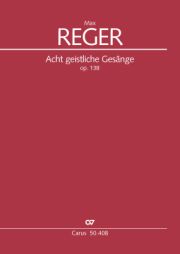 In the Acht geistliche Gesänge Reger created a series of choral pieces whose straightforward, generally choral homophonic texture is reminiscent of chorales by J. S. Bach. The harmonic structure – in contrast to that of the large-scale choral works with orchestral accompaniment – is uncomplicated, and therefore makes demands on the singers which are not difficult to meet.
CD
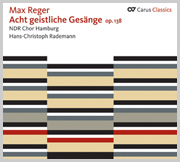 Reger worked intensively on more extended a cappella choral settings, with Bach’s motets especially serving as an important model. The first two of the Three Motets op. 110 in particular, dedicated to St Thomas’s Choir Leipzig, represent a tremendous challenge for choral singers with their closely-worked double fugues.


Leave a Reply
Want to join the discussion?Feel free to contribute!