
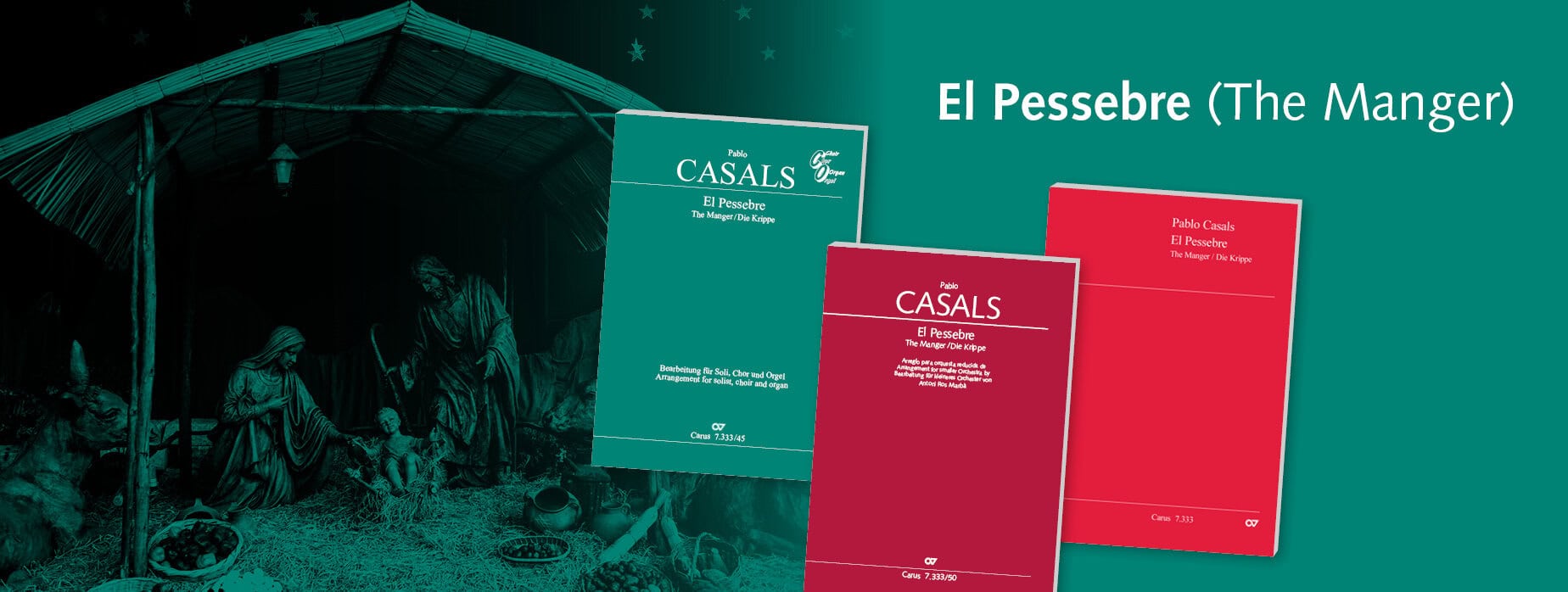
Pablo Casals: El Pessebre (Christmas Oratorio)
A musical memorial for peace and humanity
The history of music is full of works that carry a profound humanitarian message. One such work is El Pessebre (The Manger), the Christmas oratorio by Pablo Casals. Written under the influence of the Spanish Civil War and the Second World War, it became a symbol of peace and humanity.
Pablo Casals: A life marked by music and resistance
Pablo (Pau) Casals (1876–1973) was an outstanding cellist, a visionary musician and committed humanist. Born in Catalonia, he received a comprehensive musical education from an early age. As a virtuoso, he revolutionized cello playing through innovative technical approaches, and as a teacher, he shaped an entire generation of cellists. His international career as a cellist and conductor brought him together with many important artists of his time. Alongside his work as a performer, Casals composed pieces for orchestra, concertos, songs, chamber music and sacred choral music. Many of his compositions remained unpublished. During his lifetime, his church music works were the ones most widely released.
The creation of El Pessebre
Casals was not only an extraordinary musician, but also a man of deep moral convictions. The Spanish Civil War and the subsequent Franco dictatorship forced him into exile.
Casals found refuge in Prades in southern France, at the foot of the Pyrenees. In 1939, the Catalan politician, writer and translator Joan Alavedra became his housemate, together with his family. Among the meager belongings that Alavedra brought with him when he fled across the Pyrenees in January was the opening of a poem about the nativity scene that Alavedra had begun to write for his five-year-old daughter while they were still in Barcelona. The child had asked her father for Christmas not only to set up a nativity scene with many figures, but also to write a poem: she wanted to know what the figures around the manger had to say. Inspired by the child’s innocence and the purity of the Christmas story, Alavedra wrote the poem as a profound reflection on suffering, hope and humanity.
After the occupation of southern France by German troops, Casals and the Alavedra family, as opponents of Franco, lived in constant fear of house searches, interrogations and reprisals by the German occupying forces. Despite this tense situation, the Jocs Florals (Flower Games), a traditional competition for Catalan poetry, took place in Perpignan in 1943. Alavedra completed his Poema del Pessebre (Nativity Poem) and won first prize, La Flor Natural. Casals was so impressed by the power of the verses that he immediately began setting the poem to music. With this background in mind, it is easy to understand why Alavedra’s Poema del Pessebre goes far beyond a jubilant and joyful Christmas message. Time and again, thought-provoking scenes break the festive mood and remind us of Christ’s martyrdom and the transience of the world.
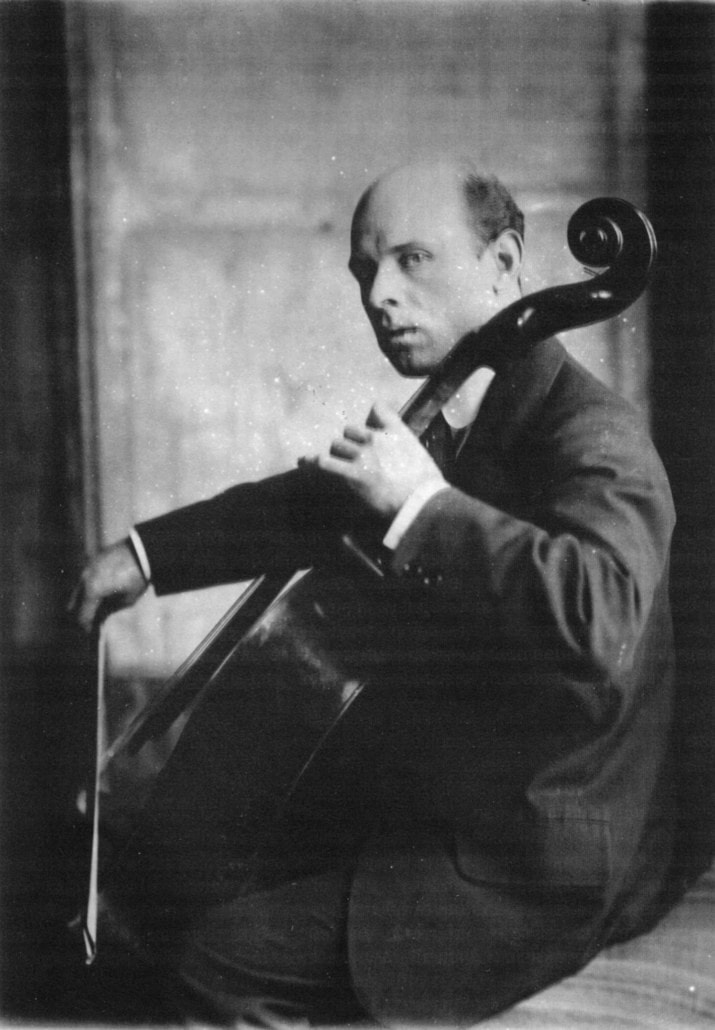
Pablo Casals am Cello
photographed by Ferdinand Schmutzer
(1870–1928)
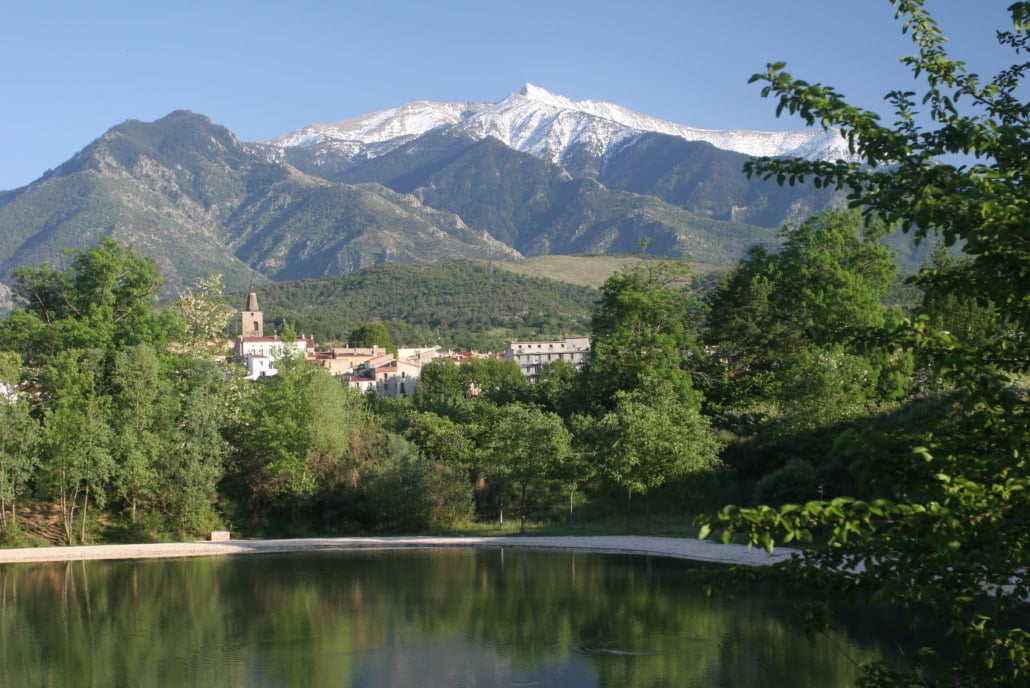
View over the village of Prades
(Pyrénées-Orientales)
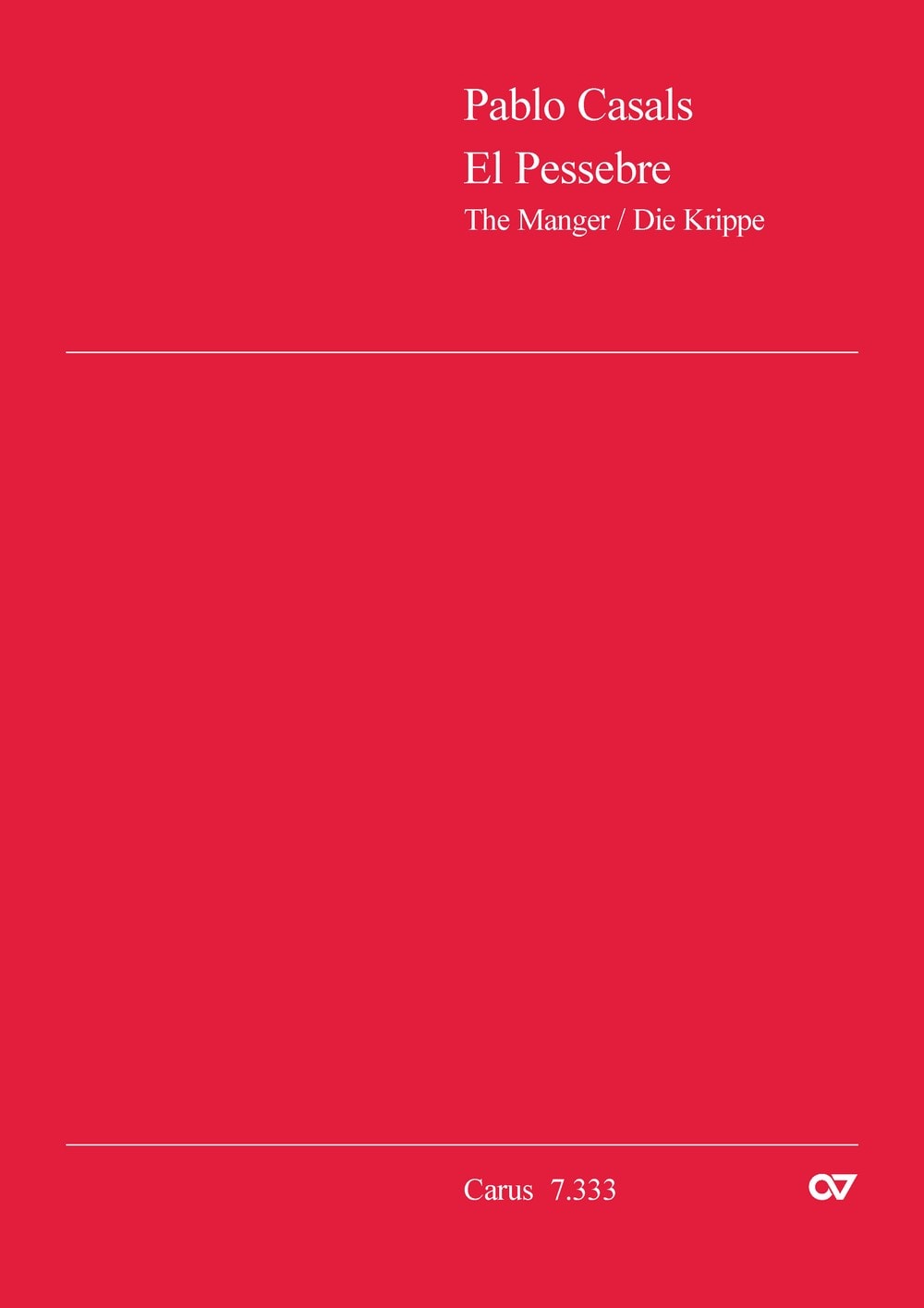
Pablo Casals
El Pessebre (The Manger)
Carus 7.333/00
Pablo Casals
El Pessebre (The Manger)
Arrangement (reduced orchestration)
by Antoni Ros Marbà
Carus 7.333/50
Structure and instrumentation
El Pessebre is a two-hour oratorio for soloists (soprano, alto, tenor, baritone, bass), choir and orchestra. In addition to the original text by Joan Alavedra, there is an English version by Marta Casals Istomin and a German version by Helga W. Pfeiffer. The revised version was edited by Rudolf von Tobel, a former student and assistant of Casals, who had also performed El Pessebre under Casals’ direction.
The large-scale oratorio is divided into several sections:
- Prologue: Prelude and the Annunciation to the Shepherds
- Part I: On the Way to Bethlehem. Scenes such as “The Man at the Well” and “The Couple at the Grape Harvest” portray a world waiting for the arrival of the Savior.
- Part II: The Caravan of the Wise Men from the East. The journey of the Magi is depicted musically, including the “Choir of Camels” and the “Choir of the Three Wise Men”.
- Part III: The Manger. In the central scenes of the work, which are introduced by an intermezzo, the focus is on Mary, Joseph and the Christ Child in the manger, but also on the ox and the donkey.
- Part IV: The Adoration. The central themes are the Holy Night, the arrival of the shepherds and the gifts of the kings and shepherds. The oratorio ends with a solemn Hosanna and Gloria.
Casals’ music is written in a pastoral, accessible tonal language and is strongly influenced by song-like elements. The work unfolds with a large choir, vocal soloists and a full orchestra, creating an impressive sound. The original version calls for a late-Romantic, large-scale instrumentation (arranged by Casals’ brother Enrique Casals), which gives the work a monumental symphonic dimension.
Orchestration:
- Woodwinds: 3 flutes (including piccolo), 2 oboes, 1 cor anglais, 2 clarinets, 1 bass clarinet, 2 bassoons, 1 contrabassoon
- Brass: 4 French horns, 3 trumpets, 3 trombones, 1 tuba
- Percussion: 3 timpani, bass drum (gran cassa), small Catalan drum (tamborí), tam-tam, tambourine, cymbals (piatti), chime bells (campanelli), triangle, castanets, 3 bells (campane)
- Harp, celesta
- Strings: 1st violins (14), 2nd violins (12), violas (10), cellos (8–10), double basses (6–7)
Various performance versions of the work
Due to the extensive original instrumentation, Carus has published several reduced versions of El Pessebre. The original vocal and choral scores are compatible with all versions.
- Original version with instrumentation by Enrique Casals (Carus 7.333/00).
- Arrangement for reduced orchestra by Antoni Ros Marbà (Carus 7.333/50), with an optional reduction from 120 to 90 minutes. In this arrangement one oboe, one clarinet, one bassoon, two horns and one trumpet are omitted from the original, and the celesta is optional.
- Version for soloists, choir and organ by Klaus Rothaupt (Carus 7.333/45). At the request of Marta Casals-Istomin, the wife of Pablo Casals, Klaus Rothaupt prepared an organ version in 2006 that allows for performances with five vocal soloists, choir and organ. The organ part is designed for a well-equipped, two-manual organ with swell.
A Christmas oratorio with a universal message
El Pessebre tells the Christmas story from the perspective of the nativity figures, yet it is much more than just a description of the birth of Christ. Pablo Casals combines religious tradition with a powerful humanistic appeal. The words go far beyond the events of the Holy Night and take into account the entire Christian story of salvation.
Originally Casals wanted to premiere the work in his homeland after the war and the liberation of Spain from the Franco regime. However, as Franco’s dictatorship continued, the opportunity for the first performance did not arise until 1960 in Mexico, which at the time had taken in a particularly large number of Catalan refugees. At Casals’ request, Alavedra added the adoration scene, which the composer set to music during his exile in Puerto Rico.
Casals conducted the work more than forty times until his death. The message was close to his heart: in a world scarred by war and injustice, he wanted to use his music to promote peace and humanity.
To this day, the oratorio remains a moving memorial for peace – and an impressive example of the power of music to unite people and give them hope.

Lorenz Adamer studied musicology and philosophy at the universities of Vienna (Austria), Cremona/Pavia (Italy) and Tübingen. He has been working at Carus-Verlag since summer 2017, initially as a sales assistant and now in the editorial department. In his spare time he is a keen clarinettist, and sings in a choir.
Camille Saint-Saëns: Oratorio de Noël
 In 1858 Camille Saint-Saëns composed his Oratorio de Noël for five vocal soloists, mixed choir, strings, organ and harp. A distinctive chamber music-like instrumentation, with lyrical soloistic parts and a modest choral part combine to create a basic pastoral mood which has led this Christmas Oratorio to become one of the most performed works by Saint-Saëns. Carus offers this work both in its original version and in an arrangement in which the choir is accompanied solely by an organ.
Herzogenberg: Die Geburt Christi (The Birth of Christ)
The Christmas oratorio Die Geburt Christi (The Birth of Christ) was first performed in 1894 in the St. Thomas Church in Straßburg. Allowing the choir to be accompanied by instruments outside the closed liturgical form of the service goes back to a concept of the theologian from Strasbourg, Friedrich Spitta. Since Christmas was a good occasion for the choir to perform independently, Spitta decided to put together the text for a Christmas oratorio and to commission Herzogenberg to realize it musically.
Arnold Melchior Brunckhorst: Die Weihnachtsgeschichte (The Christmas Story)


It’s a beautifully written introduction to Pablo Casals’s Christmas oratorio El Pessebre that highlights not only its rich musical structure and choral tradition but also how the work stands as a profound, peace centered celebration of the nativity story shaped by the composer’s experiences during war and exile.
https://www.mayabutalid.com/