
• DE
  • EN
  • Shop
  • About the Blog
  • Contact
  • Newsletter
Carus Verlag
  • Shop
  • Menu Menu
  • Categories
    • Working with choirs
    • Personalities
    • Choral works in focus
    • Music stories
    • Singing with children & young people
    • Favorite Works
  • Aufführung-Archiv
  • Search

The master of the angel’s song

César Franck and his oratorio “Les Béatitudes”

29.10.2021/0 Comments/in Personalities, Choral works in focus /by Barbara Großmann

César Franck regarded his oratorio Les Béatitudes as his most important work. The first performance of the version with piano accompaniment was given in Franck’s private apartment. But the “real” premiere of the orchestral version with over 250 performers took place only after the composer’s death in 1891 in Dijon. It was an overwhelming success, as was the Paris premiere in March 1893.

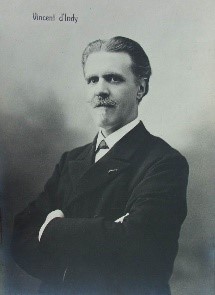
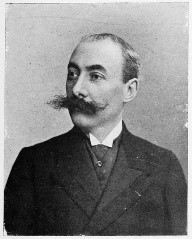
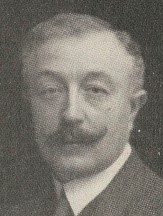
The master amongst his pupils: an imaginary snapshot from the Paris Conservatoire of the 1870s or 80s on a book cover. The “master” César Franck (1822–90) played a central role in French musical life at the end of the 19th century, as a much sought-after organist, pianist and composer, as co-founder and president of the Société nationale de musique, and as professor of organ at the renowned Paris Conservatoire, where he had a lasting influence on a whole generation of important musical personalities. The cover of “Accords perdus” shows some of his pupils. From left to right: Charles Bordes (1863–1909), Alfred Bruneau (1857–1934), Emmanuel Chabrier (1841–94), Vincent d’Indy (1851–1931), André Messager (1853–1929), Pierre de Bréville (1861–1949) and, penitent on his knees after a musical misdemeanour, Ernest Chausson (1855–1899).
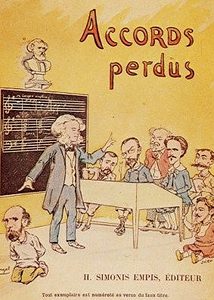
Caricature of José Engel (1868–1937) on the cover of “Accords perdus” (“Lost chords”, but also “Lost Agreement” published 1898) by the music critic Henry Gauthier-Villars (1859–1931), better known under the pseudonym “Willy”.

Previous Previous Previous Next Next Next
12345678
Open image in lightbox: C. Franck Open image in lightbox: C. Franck
Open image in lightbox: Ch. Bordes Open image in lightbox: Ch. Bordes
Open image in lightbox: A. Bruneau Open image in lightbox: A. Bruneau
Open image in lightbox: E. Chabrier Open image in lightbox: E. Chabrier
Open image in lightbox: V. d'Indy Open image in lightbox: V. d'Indy
Open image in lightbox: A. Messager Open image in lightbox: A. Messager
Open image in lightbox: P. deBreville Open image in lightbox: P. deBreville
Open image in lightbox: E. Chausson Open image in lightbox: E. Chausson

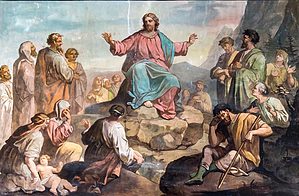
It was Ernest Chausson who was later to describe César Franck as “the man who can make the angels sing in a special way”. The “Panis angelicus” (“bread of the angels”) for tenor solo, harp, cello and organ from the Mass in A major op. 12 (CFF 203) is perhaps César Franck’s best-known sacred work of all. But he himself described his oratorio Les Béatitudes (op. 25, CFF 185) as “the best which I have done”, a work which represented for him his profession of faith and his life’s work. Here, too, he shows his mastery in the musical depiction of the heavenly spheres: an introductory Prologue is followed by eight movements setting texts from Jesus’s Sermon on the Mount (Matthew 5,3–10), in which the earthly world and heavenly comfort are contrasted with each other. The choirs on earth and in heaven play an important structural function here in the dramatic portrayal and the interpretation of the text. Although the libretto by Joséphine-Blanche Colomb (1833–1892) sometimes received less than flattering reactions (for example, by another well-known pupil of Franck, Claude Debussy), it offers a dramatically unified framework for a musically very varied form and leads at the end to an eschatological vision of human destiny: the fight of evil against goodness ends with the defeat of Satan, the victory of Christ and the entry of the faithful into paradise.

Arsène Robert (1830–1895), „Le Sermon sur la montagne“
Église St. Martin de Castelnau-d’Estrefonds (CC BY-SA 4.0, via Wikimedia Commons)


This contrasting juxtaposition of heavenly highs and earthly lows also runs through other works by César Franck, for example the “poème-symphonie” La Rédemption, for which he temporarily interrupted work on Les Béatitudes. Franck portrays the earthly hustle and bustle through striking rhythms and “heavy” bass lines, whereas the heavenly spheres are depicted through long melodic cantilenas and gentle figurations in the strings or harp sounds. In an early stage of the composition Franck the organist always noted the required instrumental “register” of the orchestra which he had in mind for each of the sections, and he masterfully understood how to use the washes of sound of the instrumental and vocal choirs to achieve the right musical expression.

César Franck
Mass in A major (orchestral version)

  • full score: Carus 40.646
  • choral score: Carus 40.646/06
  • set of parts: Carus 40.646/19

César Franck
Les Béatitudes 

  • full score: Carus 10.393
  • vocal score: Carus 10.393/03
  • set of parts: Carus 10.393/19

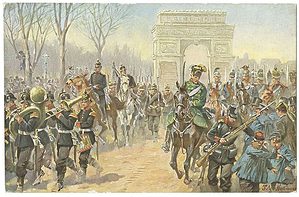
Entry of German troops into Paris on 1st March 1871
(Landesarchiv Baden-Württemberg, Abt. Hauptstaatsarchiv Stuttgart, M 703 R968N24 / Schlachtenmaler Neumann, Fritz, München (Bayern); Verlag Hans Kohler & Co., München; Bild XII der Postkartenreihe „Aus großer Zeit. Bilder aus dem deutsch-französischen Krieg 1870/71“ https://www.landesarchiv-bw.de/plink/?f=1-116324-1)

Les Béatitudes was composed at a time when Franck could also personally experience what he emphasized in the second movement: “Le ciel est loin! La terre est sombre! (The heavens are distant, the earth dark).” He wrote this music in 1870 in Paris under Prussian artillery bombardment during the Franco-Prussian War. Whereas French citizens such as Saint-Saëns, Fauré, Massenet, and Bizet served in the Garde nationale and defended the city, as a native Belgian, Franck never took French citizenship. Although he did not have to report for duty, the majority of his pupils were at the front, and normal teaching at the Conservatoire largely came to a standstill. The professor had time to compose.

Work on Les Béatitudes stretched over ten years – from 1869 to 1879. It is hard to imagine that such a monumental work, which the composer regarded as his magnum opus, only received its premiere in the version with piano in his private apartment. The performers were students at the Conservatoire and young artists from the Opera. And to crown it all, the evening before, Franck had trapped his hand in a door, so that he could not play the piano. Vincent d’Indy had to deputise at short notice. Under these conditions it is hardly surprising that the first performance was not a success. Disappointed by this failure, for the rest of his life Franck only performed individual movements from the work, and he probably never heard some of the movements in the orchestral version.

Only after the composer’s death did a complete performance of Les Béatitudes take place in the orchestral version. This “real” premiere, with over 250 performers in Dijon in 1891, was an overwhelming success, as was the first Paris performance in March 1893. Joël-Marie Fauquet called the work the “mystical high point of the 19th century”.

Foto: Barbara Grossman

Barbara Grossmann has worked as an editor at Carus-Verlag since 2004, with a focus on the music of French composers, among other things. She leads various choirs herself and plays the violin and viola.

César Franck

Previous Previous Previous Next Next Next

Les Béatitudes

César Franck (1822–1890) is now regarded as one of the most important French composers and organists of his time. “Les Béatitudes”, his monumental oratorio setting the text from Jesus’s Sermon on the Mount (Matthew 5,3ff.), is regarded as his most important work and is on an equal footing with the great oratorios of the 19th century. 

Shop

Mass in A major (orchestral version)

This edition contains both the orchestral version as well as a reduced (non-origina) l version with organ instead of wind instruments.

Shop

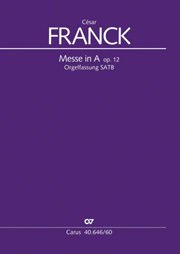
Mass in A major (organ version)

César Franck’s great orchestral Mass in A major of 1861 is one of the works which the composer wrote for liturgical use at St. Clotilde in Paris, the church where he played for many years as a famous organist and organ improviser. 

Shop

Panis angelicus

Shop

Psalm 150

The present setting of Psalm 150 from 1884 is one of César Franck’s late works. It shows the highly individual elements of the composer’s style in concentrated form. 

Shop

Five short sacred compositions

Shop

0 replies

Leave a Reply

Want to join the discussion?
Feel free to contribute!

Leave a Reply Cancel reply

Your email address will not be published. Required fields are marked *

Our newsletter

Stay informed with our free monthly newsletter!

Subscribe

Performance Calendar

  • Daniel Stickan / Friedrich von Mansberg / William Shakespeare
    Was ihr wollt. Ein junges Musical nach der Komödie von William Shakespeare
    10.06.2026
  • Peter Schindler / Christian Gundlach
    Kleiner Stock, ganz groß. Ein Waldmusical
    11.06.2026
  • Rainer Bohm / Gabriele Timm-Bohm
    Krach bei Bach. Musical
    13.06.2026
» All performances

Latest Articles

  • Banner Spohr en
    Louis Spohr: Des Heilands letzte Stunden (Calvary)05.03.2026 - 15:14
  • Beethoven Banner en
    Beethoven 2027 – Beethoven Choirs21.01.2026 - 15:07
  • Zuzanna Koziej Banner EN
    6 Questions for Zuzanna Koziej14.01.2026 - 08:56
  • 6 Questions for Christoph JK Müller07.01.2026 - 12:30

Tag Cloud

A capella (2) Adventszeit (1) anniversary (8) Arrangements (1) Bernius (1) Brahms (3) Bruckner (4) Burgmüller (1) Cantata (10) Carus Anniversary (1) CARUS Highlight (17) Carus Jubiläum (2) Charpentier (1) Cherubini (2) chorissimo (1) christmas (5) composers (26) Dvorák (1) Fanny Hensel (1) Fauré (3) females featured (1) Franck (1) Fux (1) Great choral works for small scorings (1) Hasse (2) J. Bach (1) Komponisten (2) Kraus (1) Kuula (1) Mass in D minor (1) Messe (1) Missa solemnis (1) Musical (2) My favorite Schütz (10) Opera (6) Orchestral works (1) Peter Schindler (2) Ravel (2) Scarlatti (1) Te Deum (2) Telemann (2) Verdi (2) Vierne (2) Vivaldi (1) W. F. Bach (1)

Categories

  • Opera
  • Working with choirs
  • Personalities
  • Choral works in focus
  • Music stories
  • Singing with children & young people
  • Favorite Works
  • Carus editors' place

Archive

Information

Link to the Carus webshop
Privacy Policy
Cookie Declaration
Imprint

Follow Us

  • Facebook
  • Instagram
  • YouTube
  • LinkedIn
  • Spotify

Contact

Carus-Verlag GmbH & Co. KG
Sielminger Straße 51
70771 Leinfelden-Echterdingen

Phone: +49 / 711-797 330-0
email customer service: [email protected]
email blog team: [email protected]

Link to: Charpentier’s Compositional Talent Link to: Charpentier’s Compositional Talent Charpentier’s Compositional Talent Link to: J. S. Bach: St. John Passion Link to: J. S. Bach: St. John Passion J. S. Bach: St. John Passion
Scroll to top Scroll to top Scroll to top