
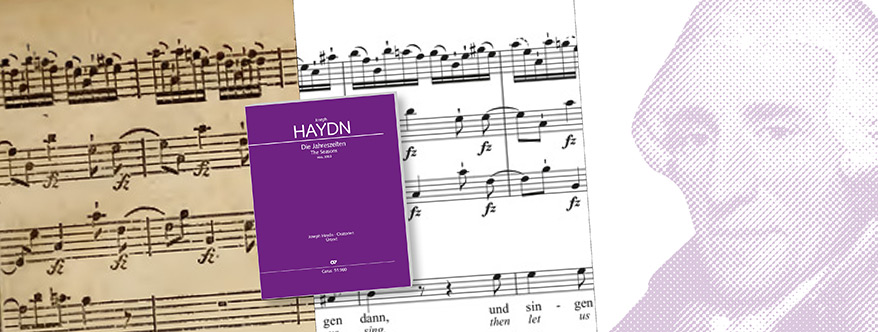
A cocktail of sources
Insights into the editorial work on Haydn’s oratorio “Die Jahreszeiten” (The Seasons)
What is an Urtext edition based on if there is no surviving autograph? Which discoveries does a comparison of different sources allow – whether these are copies or printed editions, parts or scores? Where are mistakes always found? The musicologist Ernst Herttrich has edited works including Beethoven’s masses in Urtext editions for Carus. In his new edition of Haydn’s oratorio “Die Jahreszeiten”, he reveals what can be deduced from studying the different sources and why this edition is based on several sources.
The surviving sources for Haydn’s oratorio Die Jahreszeiten (The Seasons), one of his most frequently-performed oratorios, are poor. As is the case with his other great oratorio Die Schöpfung (The Creation), the autograph manuscript no longer survives. For a scholarly edition, that is always to a certain extent the “worst case”, for we have to assume that all subsequent sources contain errors. However, whereas a copyist’s score of the full score carefully corrected by Haydn exists for Die Schöpfung, that is not the case with Die Jahreszeiten.
There are three relevant sources:
A. A copyist’s score made by Haydn’s regular copyists Johann Elßler and Joseph Arthofer, but which is incomplete as it lacks the staves for trumpets, trombones, and timpani, and quite often also for clarinet. The manuscript was intended to be a conductor’s score from the outset, so that these instruments could be omitted. The source for this was the missing autograph manuscript, or a further score made based on this.
B. Parts also prepared by Elßler which were used for the first performance. The headings to the introductions are by Haydn, and in addition to these, just a very few entries in various parts. The violin I part is laid out as a conductor’s part with cue notes. As matching variant readings show, the same manuscript must have served as the source as for source A.
C. The first printed edition published by Breitkopf & Härtel in 1802. The edition was published in two differing printings, one with French text underlaid, and the other with English. The engraver’s copy was a manuscript score, but this cannot have been identical with the sources for A and B.
Editorial experience shows that, surprisingly enough, as a rule autograph manuscripts contain hardly any mistakes in the true sense, but are perhaps careless in the placement of slurring, dynamic markings, and suchlike. Thus, when compared with subsequent sources, whether manuscript or printed editions, they are never really free of errors. Neither copyists, engravers, or composers make good proof-readers. Anyone who has ever been in the situation of having to proof-read his or her own work knows that the level of errors can be quite high. Haydn’s checking through of the manuscript parts for the first performance cannot have been particularly careful, for a whole range of obvious mistakes remain. In measures 11ff of the Overture, for example, in the bassoon II part the ‘col Basso’ marking continues, although the wind instruments clearly have rests from this measure.
No error-free sources
None of the three sources listed is therefore even remotely error-free, least of all Source A, which was intended to be an orientation for the conductor, but was never intended to provide an authoritative musical text. It was important that, for example, the timpani beat which imitates the sound of the shot in Simon’s Aria no. 26 (measure 61) was precisely notated, but it was not so important – according to contemporary conventions – that details of individual dynamics, articulation or phrasing were so precisely indicated. All three sources differ from each other in these respects in numerous details.
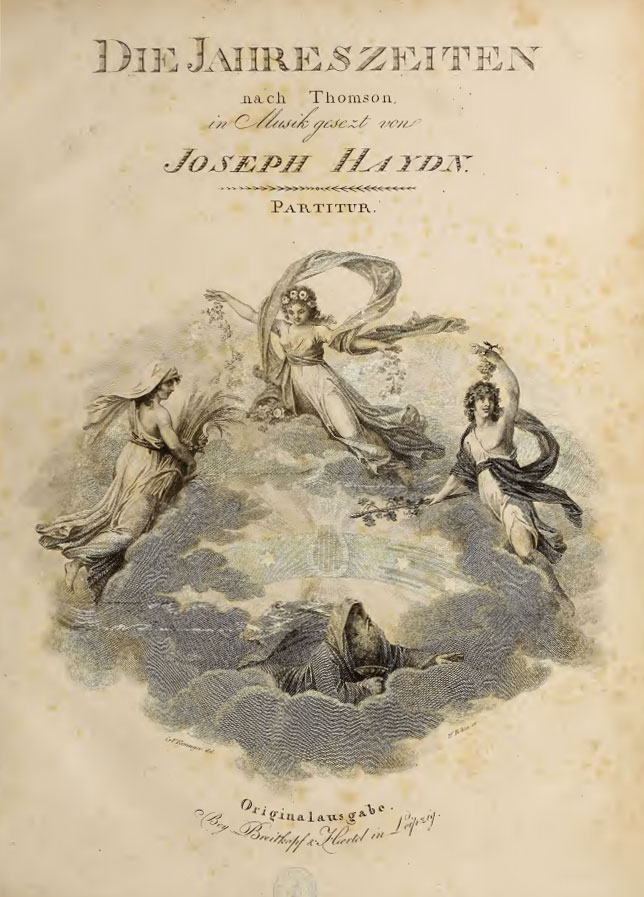
The first print of the oratorio from 1802
Haydn: Die Jahreszeiten (The Seasons)
 Haydn’s great late work in a modern Urtext edition. In compositional terms, in The Seasons Haydn follows on from formal elements in The Creation in many respects, but at the same time continues these in independent, innovative ways. So here, a fresh and creative power is seen which is in no way inferior to that in Die Schöpfung.
Haydn: The Creation (Die Schöpfung)
 The primary source on which the Carus Urtext edition is based is the first edition of the score from 1800. The critical report provides all of the important data concerning the edition in a compact form suitable for practical performance. A detailed foreword offers insight into the genesis of the work, its construction and reception and illuminates compositional and theological and spiritual-historical aspects.
In addition to this, as the autograph is missing to check against, the situation regarding the sources is particularly challenging for an editor. The relevant editions to date have also taken very different approaches: the old Complete Edition (the volume with Die Jahreszeiten was published in 1922) was based on the first printed edition as the primary source, and by contrast the new Complete Edition (the volume with Die Jahreszeiten was published in 2007) is based on the manuscript sources which were made for the first performance. Other newer editions are based more on the first edition.
A “cocktail of sources”
Normally, the rule for a scholarly edition is that one particular source should serve as the basis, and that we should avoid choosing Source A for one passage, and Source B for another, resulting in a kind of “cocktail of sources”. However, with this edition I decided to use the parts from the first performance, Source B, as the primary source, but to also take account of variant readings in the first edition. The main difference between the printed edition and the manuscripts is that the printed edition frequently contains dynamic and articulation markings which are missing in both Sources A and B. In this respect, Haydn was in fact sparing in providing his works with such markings and those in the first edition perhaps go beyond his usual habits. On the other hand it contains information which shows such an independence that it seems scarcely possible that an engraver of the time would have “invented” these on his own authority. The only conclusion which can be drawn is that Haydn himself made such additions.
A perfect example of this is the articulation of the two violins in measures 184-187 in the final chorus of the “Herbst” (Autumn) section: in the two manuscript sources the violins are unmarked, but in the first printed edition they have a very specific legato-staccato articulation which gives life to the whole. As there is not much happening in the choral parts at this point, this is a welcome addition which could well have been made by Haydn. The variant readings in Sources A and B might generally be closer to Haydn, and those in the first printed edition might partly represent a kind of “final authorised version”.
The Carus edition
In the new Carus Urtext edition, articulation markings found only in the first printed edition are highlighted graphically so that the source can be clearly identified. For practical performance, the articulation guidelines, presumably authentic, are therefore clear. As well as this, the performance material is laid out so that various original different scorings can easily be realised.
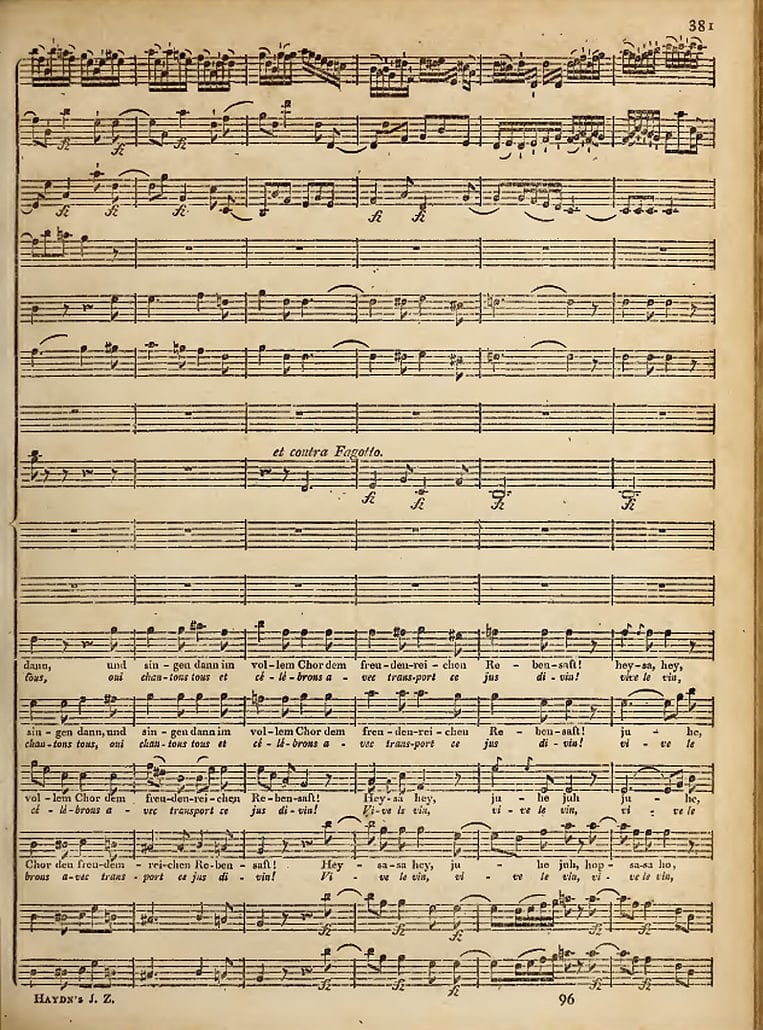
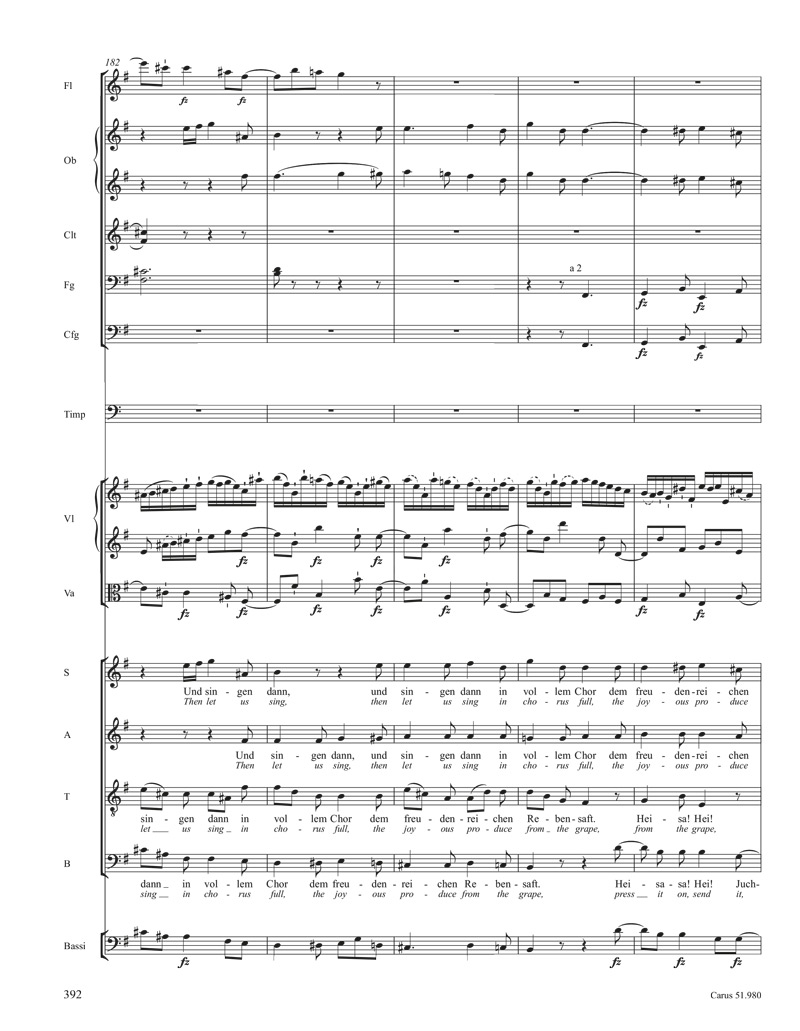
In the first printed edition the violins have a very specific legato-staccato articulation in the “Autumn” section which gives life to the whole.


Leave a Reply
Want to join the discussion?Feel free to contribute!