
A direct route or a detour?
In search of Bach in his music library
It is an exciting undertaking to research the intellectual and musical horizons of a great composer. What Bach was interested in, whether it be musical, literary, theological or even the natural sciences, what was in his music cabinet apart from his own compositions – this sometimes arouses greater attention than studying well-known works by the composer for the umpteenth time.
Recently, a few discoveries have caused a stir which show the “mature Bach” to be less of a creative genius than a pragmatically thinking choirmaster and scholar. They allow us to observe Bach’s music-historical and contemporary milieu through his eyes. At any rate this is how it seems when we study or perform works from Bach’s music library. And for this reason, the genius is no longer on such a high pedestal! We almost seem to get closer to him this way than through intensive study of his compositions alone. When we imagine him in practical terms as a choirmaster with daily tasks to be dealt with pragmatically, we can more easily relate to him directly – and we then also get somewhat closer to his way of thinking.
With Mozart, Beethoven and Bach, people had a keen interest in their music libraries from very early on. From shortly after their deaths, catalogs of their material possessions were compiled, but there was one big drawback with these: such lists were by not drawn up to outline their possessions in real terms – such as for future generations interested in music – but in order to gather together relevant information relating to tax or inheritance. So what appears here is less in the way of musical sources than goods which could be much more clearly quantified: household possessions, clothing, books, stocks, and share certificates were mainly listed in detail. But it is precisely what interests us most keenly that we can barely find in this inventory of possessions: what was it that inspired a composer to perform works by others? What did he hope to learn from this and how did he approach these works creatively?
Dr. Christine Blanken studied Historical and Systematic Musicology and German Language and Literature at the Universities of Göttingen and Vienna. From 1999 to 2005 she was a research assistant at the Johann-Sebastian-Bach-Institut Göttingen; she has worked at the Bach-Archiv Leipzig since 2005, where she is the head of Research Department II.
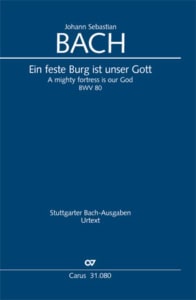
Johann Sebastian Bach
A mighty fortress is our God
Cantata for Reformation Day. Reconstruction Klaus Hofmann
BWV 80 (BWV3 80.3)
In Bach’s case, in the “Specificatio der Verlaßenschaft,” drawn up in autumn 1750 there are 52 entries listed under the heading “An geistliche Büchern” (sacred books), but corresponding chapters listing other literature or even his music collection are missing completely. Bach himself was active as a bidder at book auctions, and would have made assiduous use of these opportunities to add to his own library. The search for surviving music which contains his handwriting has been going on for decades. This is only progressing slowly, for here much specialist knowledge is necessary which can only be gained in a fragmentary way and above all, only by investigative methods – through precise knowledge of his handwriting and its chronological stages, the characteristics of the handwriting of his many copyists, the manuscript paper he used, and the usual and unusual routes of transmission of sources written by him. The somewhat easier part of this task lies in examining the portion of his legacy which went to his son Carl Philipp Emanuel. As a large part of this still exists and C. P. E. Bach himself later compiled an inventory of his legacy – and this really is a listing of his father’s compositions as well as his music library – many discoveries have been made here in the past.
The most famous of these is the so-called “Alt-Bachisches Archiv,” a collection of music in the possession of his father predominantly from Arnstadt by older members of the Bach family. Numerous other works from this part of the inheritance were published a long time ago and are well established in current musical repertoire; these include the Markus Passion (Carus 35.502), previously attributed to Reinhard Keiser, the Brockes Passion by Handel (Carus 55.048) and the Stabat mater by Pergolesi, which Bach performed in an arrangement translated into German (Tilge, Höchster, meine Sünden, Carus 35.302) – and even a few cantatas by his friend Georg Philipp Telemann. But here we have by no means reached the end of the story, which is why Bach scholars have endeavored for several decades to create a reconstruction of what was definitely a considerable music library in Bach’s residence in St. Thomas’s churchyard in Leipzig
The most extensive group of works from this music library are the settings of the Mass, the nucleus of which had been assembled in his Weimar period or earlier: this includes two complete masses by Giovanni Pierluigi da Palestrina (Carus 35.301, Carus 35.501), six by Giovanni Battista Bassani, further works by Johann Baal and Bach’s distant cousin Johann Ludwig from Meiningen; Kyrie and Gloria Masses by Francesco Durante (Carus 35.008), Antonio Lotti (Carus 40.661), Johann Christoph Pez (Carus 35.006), Johann Hugo von Wilderer (Carus 35.309 in preparation) and an anonymous composer (BWV Anh. 25, Carus 35.007 in preparation), as well as a Kyrie by Marco Giuseppe Peranda (Carus 35.306) and a Sanctus by Johann Caspar Kerll (Carus 35.303).
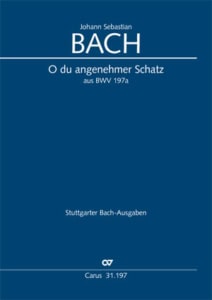
Johann Sebastian Bach
O you pleasant sweetheart
Cantata for the 1st day of Christmas. Reconstruction Diethard Hellmann
BWV 197a, 4 (BWV3 197.1), 1728
The latest discoveries made by Bach researchers in Leipzig include further individual discoveries from Bach’s library which have survived in other ways, little known until recently: a four-part Kyrie-Gloria Mass in E minor, previously unattributed, copied out in Bach’s hand and discovered by Peter Wollny in the church archives in Mügeln, Saxony, and a four-part canonic mass by Francesco Gasparini (Carus 35.503), recently also discovered by Wollny in the music archive of the Weissenfels Stadtkirche. These once again confirm that the mature Bach not only made intensive use of older, largely contrapuntally-influenced Italian church music, using works as preparatory study models for his own compositions, most notably the Musical Offering, the Art of Fugue and the B minor Mass. Generally speaking, stile antico works of his (fore)fathers’ generation were still very much an established part of the repertoire in church services in his day, including the motet collection Florilegium portense (1618/21) by Erhard Bodenschatz of Schulpforta. This had been used by several generations of choirmasters at St. Thomas’s before him, and during his period in office he even acquired several new copies of it. But apart from the few works by Bach himself, what was performed in the way of Sanctus and Magnificat compositions at the main churches services in Leipzig remains largely unknown.
With many of the mass compositions, Bach himself intervened, although very discreetly: he added further instruments to a primarly vocal-contrapuntal movement (which are almost always colla parte with the voices) and figured continuo parts. With this he adapted stile antico works to local conditions, performance and audience traditions. In the case of Leipzig this included responding to the acoustic demands of the two large city churches of St. Thomas and St. Nicholas. Bach evidently found a broad, instrumentally-supported sound (such as he usually employed in motets and motet-like movements in cantatas) far more effective than a pure vocal sound. This task should not be regarded as an independent, let alone creative act, but as a pragmatic necessity similar to that frequently carried out by choirmasters over the generations.
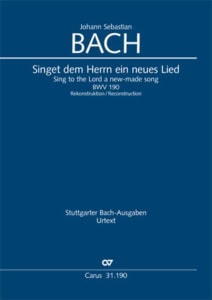
Johann Sebastian Bach
Sing to the Lord a new-made song
Cantata for New Year’s Day. Reconstruction Masaaki und Masato Suzuki
BWV 190 (BWV3 190.1), 1724
Carus 31.190/00
Only in a few cases were works subject to more drastic intervention by Bach: a movement such as the independent Christe eleison BWV 242 newly added to the Mass by Durante, or a few newly added obbligato instrumental parts, such as to the Sanctus BWV 241 of the Missa superba by Johann Caspar Kerll – to name just a few movements from the Mass.
It is tremendously worthwhile performing Bach’s works in modern concerts alongside compositions from his music library, more than for simply becoming familiar with earlier church music; such juxtapositions allow a picture of Bach to emerge which place him in a clearly defined historical context, as he should also be seen today. It is equally worthwhile programming compositions from the 19th to 21st centuries alongside Bach’s works – such as works by Reger on the hundredth anniversary of his death in 2016. Without Bach, these cannot be appreciated. In the words of Bach himself: “What I have been able to achieve through industry and practice, anyone with a bit of temperament and skill can also achieve.”
A mighty fortress is our God BWV 80b
 The Reformation cantata Ein feste Burg ist unser Gott BWV 80b, published by Carus-Verlag for the first time in a practical performing edition, remained unknown to Bach scholars until well into the 20th century. The evidence of its existence is three fragments of the first folio of Bach’s score, which can be dated to the years 1728-1731. By contrast, the long-familiar expanded new version of the cantata with its powerful opening chorus (BWV 80) dates from the 1730s or 1740s. It only survives in a copy of Bach’s score, but this allows conclusions to be drawn about the history of the versions; thus, by using the fragments mentioned above, it has been possible to reconstruct the first version.
Rest thy faith on God the Lord
“Gott ist unsre Zuversicht” BWV 197 was probably written in the second half of the 1730s for a wedding, no further details of which are known. In the opening chorus in particular, it features quite a sizeable orchestra. The text of the cantata has one major theme – trust in God! In a magnificent lullaby (movement 3) all cares are sung to sleep. The other arias, with their exceptionally exquisite combinations of scorings, make the cantata into a quite special work, albeit one which is associated with a particular occasion.
Christoph Wolff: Bach vocal. Handbuch


Leave a Reply
Want to join the discussion?Feel free to contribute!