
“In Salzburg! The home of the buffoon!”
Wolfgang Amadeus Mozart: Der Schauspieldirektor (The Impresario)
1786 was Mozart’s busiest year. In a frenzy of activity he wrote piano concertos, chamber music and his opera Le nozze di Figaro; he organized his own concerts and attended balls – and he also entered into an operatic competition with court Kapellmeister Antonio Salieri, as ordered by the Emperor: Italian opera buffa versus German Singspiel. Mozart wrote his Schauspieldirektor, a satire on the eccentricities and vanities of the theater world, in just fourteen days.
Origin and reception
The Habsburg Emperor Joseph II was not only a monarch with a traditional musical education, but also a friend of musical competition. For instance, on Christmas Eve 1781 he invited composers and pianists Muzio Clementi and Wolfgang Amadeus Mozart to a duel on the pianoforte, not least to entertain his guests, the son and daughter-in-law of the Russian Tsar. Then at the beginning of 1786 the Emperor requested a “composers’ duel” between Mozart and the court Kapellmeister Antonio Salieri on the occasion of the visit to Vienna of his sister Marie Christine and her husband, Duke Albert of Saxony-Teschen. Two stages were specially set up opposite each other in the Orangery of Schönbrunn Palace, so that the composers’ works could be performed one after the other.
On February 7, 1786, the duelling composers presented their compositions in two distinct genres. Mozart had been commissioned to compose a one-act German Singspiel as representative of the German National Theater, while Salieri was tasked with writing a one-act Italian opera buffa to represent the Court Opera. Both plots were satirical takes on the contemporary opera scene. Salieri chose the comic libretto by Giovanni Battista Casti for Prima la musica e poi le parole: a poet is supposed to write a text to existing music, and the scene culminates in two rival singers rehearsing their arias simultaneously. Mozart, on the other hand, collaborated again with Johann Gottlieb Stephanie, who had already written the libretto for his The Abduction from the Seraglio. His Schauspieldirektor (Impresario) tells of ridiculous vanities and comical rivalries in an opera troupe assembled by an impresario for a production.
After the first performances at Schönbrunn Palace, both one-act operas were performed on three further evenings at Vienna’s Kärntnertor Theater. Salieri’s lively, witty opera won out in direct comparison with Mozart’s dialogue-heavy “play with arias” (as the newspaper Wiener Zeitung called it at the time), even though the music is mature Mozart, with a zippy overture and witty arias. The issue was the spoken dialogue, which referred to current events; as a result, the piece quickly became outdated and needed to be revised for later performances. In 1797 Emanuel Schikaneder staged Der Schauspieldirektor at the Vienna Freihaustheater; In the same year in Weimar Christian August Vulpius combined it with Domenico Cimarosa’s comic opera L’impresario in angustie, creating the pastiche Die theatralischen Abenteuer (The Theatrical Adventures). In 1845 Mozart und Schikaneder (Mozart and Schikaneder) appeared in Berlin, based on an adaptation of Der Schauspieldirektor by Louis Schneider, in which both composers are depicted on stage. It was not until 1916 that the original Der Schauspieldirektor was performed again at the Vienna Volksoper. Since then it has occasionally been performed on small stages in combination with Antonio Salieri’s counterpart or in concert performances (without dialogue) with other works by the mature Mozart.
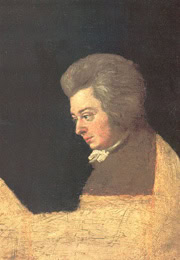
Mozart at the Piano
unfinished painting by
Joseph Lange, 1789
(Mozart Museum Salzburg)
Postcard
Carus 40.390/00
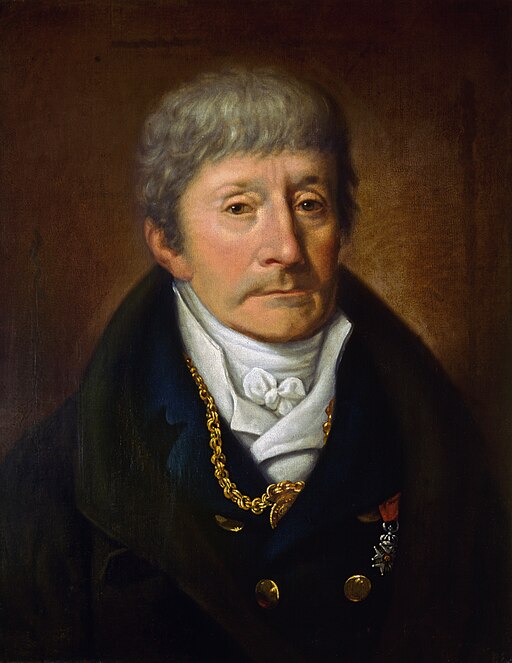
Porträt of Antonio Salieri
Joseph Willibrord Mähler, 1815
Plot and libretto
Director Frank wants to put together a troupe in Salzburg, supported by bass buffo Puf. Various actors and singers are presented, either performing scenes from current theater literature or offering a taste of their vocal skills (Arietta No. 1 and Rondo 2). The promised fees increase with each engagement. In addition, the ladies battle for the role of “first singer” (Trio No. 3). Due to the discord, Frank threatens to call off the whole enterprise. The participants then agree to subordinate their individual interests to art, a sentiment they express in the final song (No. 4): “to give preference to oneself, to rise above others, makes even the greatest artist small.”
Johann Gottlieb Stephanie later described his libretto for Der Schauspieldirektor as an “occasional piece.” This is accurate, as the many allusions to contemporary poetry and music are geared toward the time frame of a then-current “occasion.” Madame Herz’s arietta Da schlägt die Abschiedsstunde (The hour of farewell strikes) draws on examples from different contexts, cleverly appealing to a broad readership of popular muses’ almanacs in which such occasional poetry was published: Pietro Metastasio’s poem La Partenza, its German adaptation by Johann Joachim Eschenburg (Da schlägt die Abschiedsstunde), and Das Lied der Trennung (The Song of Separation) by Klamer Eberhard Karl Schmidt. Mademoiselle Silberklang’s rondo “Bester Jüngling!” is a paraphrase of Johann Martin Miller’s poem Der Liebesbund (The Bond of Love) which was printed in the Vossischer Musenalmanach (Voss’s Muses’ Almanac) in 1779.
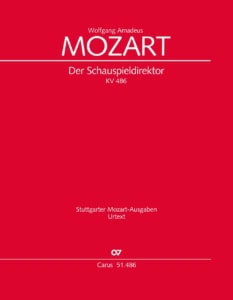
W. A. Mozart
Der Schauspieldirektor (The Impresario)
Carus 51.486/00
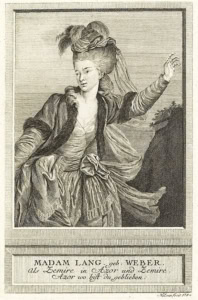
Madame Lang, née Weber
Johann Jakob Nilson, 1792
W. A. Mozart, Urs Stäuble (arr.)
Der Schauspieldirektor
Arrangement for chamber orchestra
Carus 57.007/00
Mozart’s singers and his music
The cast underscores the predominantly theatrical character of the piece. There are seven actors as opposed to just three singers – two sopranos and one tenor, and only at the very end are the singers joined by the actor Puf as a bass. With the opening sinfonia, the trio and the final song, Der Schauspieldirektor takes on an operatic framework, which is filled with a play featuring lengthy dialogues, supported by two arias at crucial points. For these roles Mozart chose prominent singers who played an important part in his personal operatic circle. Madame Herz was sung by his sister-in-law Aloysia Lange, known for her Konstanze in his Entführung aus dem Serail (and later to take the role as the first Donna Anna in the Viennese revival of Don Giovanni). The arietta composed for her combines an initial lament in G minor, reminiscent of Konstanze’s Traurigkeit ward mir zum Lose (Sadness became my lot), with a fast major key section of rapid coloratura that seems to echo Konstanze’s bravura aria Martern aller Arten (Torments of all kinds). Mozart tailored the next aria, Mademoiselle Silberklang’s rondo, to the voice of Caterina Cavalieri, his first Konstanze (and later Donna Elvira in the Viennese Don Giovanni). This aria is also in two parts, beginning with a solemn andante which is followed by a fast coloratura section. The central musical number of the entire piece is the trio with the two sopranos and the tenor of Monsieur Vogelsang. Mozart wrote this part for his close friend Valentin Adamberger, the first Belmonte in Die Entführung and recipient of several concert arias penned by Mozart. His lyrical voice rings soothingly between the prima donnas in the trio, who interrupt each other with ever higher notes, proclaiming “I am the first singer!” The actor Puf joins in for the last number, expanding the trio to form a four-part final chorus in which, in the style of a vaudeville, each of the four verses is begun by a soloist and then finished by the quartet as a refrain.
Edition
The Carus edition of Der Schauspieldirektor (Carus 51.486/00), edited by Mozart expert Dr. Ulrich Leisinger, is based on Mozart’s autograph score. Contemporary copies of this score have survived in Donaueschingen, Hamburg and Munich. While the orchestral ritornellos of the two arias are missing from the autograph, they are found in all of the copies. The editor has therefore included the ritornellos from the Munich source in this edition.
Thanks to Urs Stäuble’s arrangement of the work for chamber orchestra (Carus 57.007/00), it is possible to perform the work on an even smaller scale – ideal, for example, for a performance in an opera studio.

Dr. Henning Bey has been working as Promotion Manager for Stage and Orchestra at Carus-Verlag since October 2025. Previously, he served as Artistic Planner with the SWR Symphony Orchestra, Chief Dramaturge of the International Bach Academy Stuttgart, and Dramaturge at the Freiburg Baroque Orchestra. He gained editorial experience as a member of the editorial team of the New Mozart Edition in Salzburg.
Bastien und Bastienne

The story of Bastien und Bastienne is based on the musical pastoral “Le Devin du Village” by Jean-Jacques Rousseau. The play was hugely popular in paraphrase and translation and entered the repertoires of travelling companies and children’s theaters.
Mozart’s version, composed in Vienna in the summer of 1768, is based on a text by Friedrich Wilhelm Weiskern that had been in existence since 1764.
Requiem (Arman version)
The English conductor and composer Howard Arman has presented us with a completed version of Mozart’s Requiem. “Another one?” you might ask, since this publication is only the latest in a long line reaching back to the traditional Süßmayr version. Yet such is the enormous power of Mozart’s score that the challenge and appeal of completing it remain undiminished. After two decades of intensive study, Howard Arman’s additions to Mozart’s great original show the requisite care and respect while incorporating many new insights.
Missa in C
 Mozart’s Missa in C K. 317, erroneously dubbed the “Coronation Mass,” is among the most popular and most often performed works in this genre. Ulrich Leisinger, the editor, prepared the edition based upon what is, without a doubt, the only authentic source, although additionally in the Critical Report he has also consulted an early copy of the Mass (by Fügerl), since such later copies often help to clarify questions concerning historical performance practice.







Leave a Reply
Want to join the discussion?Feel free to contribute!