

A Must for all Mozart fans
For Maria Groß, the incomplete “Missa in c minor” is one of the most impressive Mozart mass settings.
For Miriam Groß, the Missa in C minor is one of the most impressive Mozart mass settings. The incomplete mass was not – as usual – written on the basis of a composition commission, but Mozart vowed to write a mass if he succeeded in marrying his well-known Constanze Weber. Against this background, it is not surprising that the soprano solo (the future Constanze Mozart was after all a soprano) has a very large, often operatic aria-like part in this mass. The mass was reconstruted several times; two of these versions are available from Carus.
Of Mozart’s mass settings, which I’ve always adored, the Mass in C minor KV 427 strikes me as being the most impressive. This mass, which was unfortunately never completed, was not composed in response to a commission from a prince or another prominent “client”, rather, Mozart resolved to write a mass when he succeeded in marrying his beloved Constanze Weber. Against this background, it is hardly surprising that the soprano soloist (for the future Constanze Mozart was indeed a soprano) in this mass has a major part, often operatic in style (for example in the “Et incarnatus est”).
Right from the beginning of the Kyrie I am captivated by the graceful character of the violin melody, recalling a funeral march, which ascends until the entry of the sopranos, and the resulting arc of tension up to the entry of the soprano solo: here the key changes to a radiant E flat major and forms a comforting counterpart to the previous minor key.
Another part of the mass which is one of my favorite pieces is the “Quoniam”. One section I particularly like is the syncopated figure which begins in measure 82 and the interweaving of the three solo parts (SST), in which each soloist sings both in the foreground and in an accompanying role. The conclusion of this movement, so typical of Mozart with its individually sung sylllables of the “Altissimus”, rounds off the piece beautifully.
Why this wonderful and most ambitious setting of the mass was never completed by Mozart remains a mystery. It may be linked with the birth of his first son Raimund Leopold in 1783 and his premature death (the baby died aged just two months). It is perfectly possible that the original intention behind the mass was associated with family reasons.
And for those looking for a completed version of the C minor Mass, several reconstructions are available. Carus published two different versions: Following his reconstruction of the Mozart’s Requiem , the American musicologist and acclaimed concert pianist Robert D. Levin has completed another of Mozart’s most significant works. Thus a performance of the entire ordinarium missae has finally become possible. (Of course, you can also perform the work’s torso with this edition.) Furthermore, a version by Richard Maunder is also available from Carus, with the addition of wind and brass parts in the Credo. Whichever version you choose, the mass is an absolute must for all Mozart fans!

Maria Groß studies Applied Musicology and Music Education and spent the semester 2014/15 as an intern at Carus. In her free time she sings in various choirs as well as in the in-house Carus vocal ensemble.
Full Score
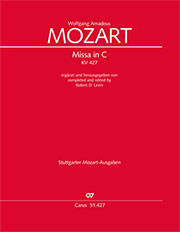 The C Minor Mass K. 427 by Wolfgang Amadeus Mozart is a fascinating work. But to speak of “the” Mass is inaccurate, for basically it is no more than a musical torso, full of enigmas and problems, yet full of magnificent music. It is hardly surprising that attempts have been made to create a performable version of Mozart’s fragment since the 19th century.
Full Score arranged by Richard Maunder
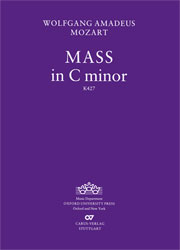 The Mass in C minor, K. 427, Mozart’s “Great Mass” remaines a torso – a circumstance which is extremely regrettable, especially given the monumentality of this work. Mozart finished only the Kyrie, Gloria, Sanctus, “Osanna”, and Benedictus of the Mass.


Leave a Reply
Want to join the discussion?Feel free to contribute!