

Voluptuous Melodies and Richly Colored Harmonies
Tristan Meister thinks Rheinberger writes his own musical language in “Cantus Missae op. 109”.
Amongst Rheinberger’s 14 mass settings, the Mass in E flat major op. 109 (Cantus Missae) composed in 1878 undoubtedly holds a special position. This mass must, in the opinion of Tristan Meister, count as one of the most important church music compositions of the Romantic period and is worthy of a place in the repertoire of every ambitious choir.
Who does not know it? The Abendlied (“Bleib bei uns, denn es will Abend werden”) by the Liechtenstein composer Joseph Gabriel Rheinberger. The familiarity of this work was both a curse and a blessing for Rheinberger, for this world-famous work was often the only piece of his choral music which people were familiar with.
But he wrote much more than just this, with 197 published works with opus numbers, including piano music, operas, organ works, symphonies, secular and sacred choral music. He lived in Munich from the age of twelve, working as a composer and composition teacher. He was one of the most successful composers of his day but, like some of his contemporaries, has only recently been “rediscovered” by the wider public and rightly acknowledged as a versatile composer.
Amongst his 14 mass settings, the Mass in E flat major op. 109 ( Cantus Missae) composed in 1878 undoubtedly holds a special position. The choice to set the mass for unaccompanied double choir is in contrast with many mass settings by his contemporaries and reflects Rheinberger’s love for the compositional forms of the Renaissance. The first measures of the Kyrie recall precisely those Venetian polychoral works in their structure. And yet from the very first note, he imbues the music with his own musical language. The grand-scale structure of this first movement, with its voluptuous melodies and richly colored harmonies which are always reined in after they begin so as to never overshadow the humble plea for mercy, make this music a very special interpretation of the text of the mass.
In the Gloria and Credo this mass stays close to the text and its direct interpretation. But here, too, Rheinberger does not limit himself to a simple setting of the mass text, but allows short fugato elements to sparkle, for example in the “Cum Sancto Spiritu”. The Credo begins with a bass intonation before each verse in its individual style is interpreted by both choirs antiphonally. The two choirs only come together in the most heartfelt emotion for the “Et in Carnatus est”. The painterly final section at first allows the sun to rise in the “Et vitam venturi” and then finds its crowning conclusion in the extended “Amen”.
An almost weightless Sanctus, followed by a lightly animated Benedictus give the mass an almost heavenly character. In the concluding Agnus Dei Rheinberger leaves nothing to chance and marks the individual sections with precise dynamics, which makes this movement tremendously rich in contrasts and variety. The final “Dona nobis pacem” is very instrumental in effect through its melismatic treatment of the text, almost recalling the late choral music of Richard Strauss.
This mass must, in my opinion, count as one of the most important church music compositions of the Romantic period and is worthy of a place in the repertoire of every ambitious choir.
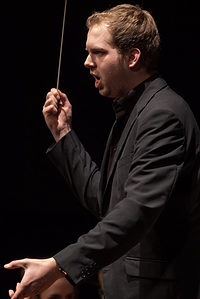
The choral and orchestral conductor Tristan Meister gives workshops and presentations for Carus-Verlag at events.
Partitur
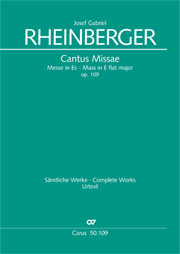 According to Otto Ursprung, Cantus missae is the “most beautiful, pure vocal music of the 19th century”. This is Rheinberger’s only Mass written for double choir. It obtains its special character through the use of compositional techniques of ancient classical vocal polyphony, which are combined with functional harmony and expressive, songlike voice-leading.
CD
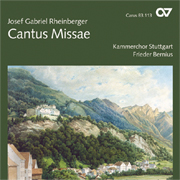 "Under the experienced direction of Frieder Bernius the Stuttgarter Kammerchor has succeeded superbly here in drawing a distinctive portrait of Rheinberger, the choral composer.” Awarded the Preis der deutschen Schallplattenkritik


Leave a Reply
Want to join the discussion?Feel free to contribute!