
Creative breadth and depth
Conductor Hans Jaskulsky admires the originality, inspiration, and the courage to take risks in Beethoven’s C major Mass
Hans Jaskulsky has had the honor of conducting this magnificent work many times. A performance was also planned in Bochum for the current 250th anniversary year of Beethoven’s birth, before the Corona pandemic prevented this. Jaskulsky is hopeful of postponing this until next year when the Mass in C will still be as exciting and impressive.
For a conductor the favorite work is often the work which he or she is currently working on and performing. Carus-Verlag’s extensive catalog of publications doesn’t make it easy to select a single work among so many favorite pieces, and yet, my choice might owe something to the Beethoven anniversary year. One of my favorite pieces is without doubt the Mass No. 1 in C major op. 86 by Ludwig van Beethoven. It exemplifies the creative breadth and depth, the breathtaking novelty of his work.
Beethoven wrote on 8 June 1808 to a publisher: “… I do not speak gladly of my Mass or of myself, but I do believe that I have treated the text in a manner such as only a few have treated it before …”. And indeed, originality, inspiration, and the courage to take risks are evident in the Mass. Beethoven’s will and his ability to conceive the text of the Ordinarium Missae so frequently set over the centuries for symphonic forces, thus creating links between the genres of Mass, symphony, unaccompanied choral music, and even solo concerto continue to inspire and surprise me.
The Mass in C was composed around the same time as the Violin Concerto in D major and the 5th Symphony in C minor (“Fate Symphony”), and was commissioned by Prince Nikolaus Esterházy in Eisenstadt near Vienna. The premiere of the work took place there on 13 September 1807 conducted by Beethoven. A few years earlier, between 1796 and 1802, Beethoven’s teacher Joseph Haydn had composed his six late masses for the choir and orchestra at the Esterházy court – all masterworks of the genre. Beethoven felt impelled to be measured against these works and indeed wanted to be.
Even the formal structure of the work makes you sit up and take notice: five large, symphonically through-composed movements leave everything up to that point behind. Instead of the conventional sequence of choral numbers and solo arias or ensembles, the parts for the soloists and the chorus fit into a well-considered overall compositional context. The 3rd movement in particular, the “Credo”, impressively demonstrates how the motivic development in the instrumental writing ensures the great symphonic continuity of the individual sections of the movement.
Of course, Beethoven still retained the classic division of the movement into three sections: Allegro con brio (measures 1 ff., “Credo in unum deum…”); Adagio (measures 131 ff., “Et incarnatus est”); Allegro ma non troppo (measures 183 ff., “Et resurrexit…”). And indeed, he ended the movement quite traditionally with a fugue (“Et vitam venturi saeculi. Amen”). And yet, the unusual freedom of a strongly modulating harmony in a fugue, the unusual division of the fugue sections between choir and soloists, and the majestic, obbligato treatment of the orchestra which moves from simple accompaniment to equal partner in dialog with the vocal parts – all this and much more besides is highly original and marked the beginning of a new chapter in settings of the Mass. The human voice itself becomes one instrument among many in the symphonic texture.
Beethoven further developed this approach in his Choral Fantasy op. 80, in the fourth movement of the 9th Symphony op. 125 (with Schiller’s “Ode to Joy”), and in his major sacred work, the Missa solemnis op. 123. It is hardly surprising that the composer of Fidelio showed himself in the Mass in C to be a master at setting the venerable Latin text.
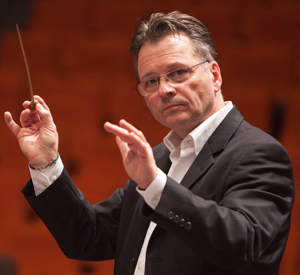
Prof. Hans Jaskulsky is chairman of the “Internationaler Arbeitskreis für Musik e.V.” From 2011 to 2018 he was President of the “Bundesvereinigung Deutscher Chorverbände e.V.”. In 2018 he was awarded the German Federal Cross of Merit by the President. Jaskulsky’s repertoire as a conductor ranges from unaccompanied choral music to choral-symphonic works and orchestral works in a wide range of styles, from Renaissance works to premieres and first performances of new compositions.
Performance material
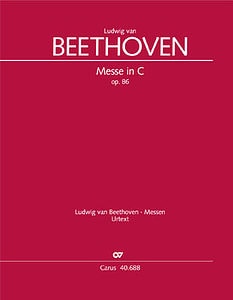 With its tonal language of subjective avowal, the first of Beethoven’s two masses opens up new worlds of expression for the liturgical texts of the Mass which are expressly modern and point towards the future. Not to be considered a preliminary work to the Missa solemnis, it is an entirely independent work which set standards for the further development of settings of the Mass in the 19th century.
CD recording
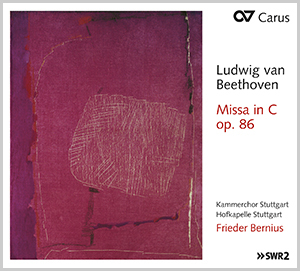 The Kammerchor Stuttgart, under the direction of Frieder Bernius is one of the finest choirs worldwide. Now Frieder Bernius presents Beethoven’s Missa in C major (op. 86). The world premiere recording of Luigi Cherubini’s Sciant gentes (1829) rounds out this CD.


Leave a Reply
Want to join the discussion?Feel free to contribute!