
“much of it is very beautiful and at times so free”:
Des Heilands letzte Stunden (Calvary) by Louis Spohr
Louis Spohr and Felix Mendelssohn had much in common: beyond a personal friendship, they shared a passionate commitment to the music of Johann Sebastian Bach and were hugely popular composers in Great Britain. In 1829, Mendelssohn put Bach’s St Matthew Passion back on the musical map with his sensational performance in Berlin; from 1832 onwards, Spohr did the same with several performances in Kassel. Inspired by Bach’s monumental work, both men composed a major oratorio: Mendelssohn his St Paul, and Spohr Des Heilands letzte Stunden. In 1836 and 1837, these works enjoyed their successful British premieres. Numerous performances followed until the end of the century, with both oratorios becoming a staple of musical life on the British Isles. With this critical edition, Carus is presenting the first modern edition of a significant work by Spohr.
The work’s origin
Louis Spohr (1784–1859) wrote four sacred oratorios, all of which explore apocalyptic themes: Das Jüngste Gericht (The Last Judgement) (1812), Die letzten Dinge (The Last Things) (1825), Des Heilands letzte Stunden (Calvary) (1834/35), and Der Fall Babylons (The Fall of Babylon) (1839). The initative for the third oratorio came from the well-known Leipzig music publicist Friedrich Rochlitz, who urged Spohr in 1833 to set his libretto to music. Shortly before this, Rochlitz had offered it to Felix Mendelssohn, who had rejected it in favor of St Paul. Inspired by his own performances of Bach’s St Matthew Passion, Spohr began composing the new oratorio in Spring 1834. The work was overshadowed by the deteriorating health of his wife, Dorette, who eventually died on 20 November 1834. The composer noted the date of her death on the autograph score at Chorus No. 24: “Save now thyself, thou who savedst others!”. Des Heilands letzte Stunden (Calvary) was completed in Spring 1835 to be premiered shortly thereafter on Good Friday. Moritz Hauptmann, an orchestral violinist in Kassel and a close friend of Spohr, wrote in a letter on 3 April 1835, two weeks before the premiere: “I have not yet heard the music in its entirety, and some of the solo parts not at all; but of what I know, much of it is very beautiful and at times so free – the likes of which I have rarely known from Spohr.”
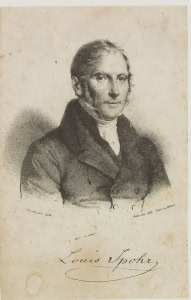
Louis Spohr
1784 – 1859
Performance history, especially in Great Britain
Des Heilands letzte Stunden enjoyed a triumphant premiere at Kassel’s Garrison Church on Good Friday 1835. Spohr reported contentedly to Rochlitz in a letter dated 20 April that the performance “turned out exactly as desired and, from everything I hear, the work seems to have made a deep impression. […] Despite the church being so packed and the audience so mixed, a profound silence reigned before and during the music, which also put us players into the right frame of mind. As a result, the work was realized from start to finish without any mishaps and was found by everyone to be most uplifting.” After its debut, the oratorio travelled to numerous German cities, where it was often met with rapturous acclaim. At this time, Louis Spohr already enjoyed long-standing and strong ties to Great Britain, dating back to his first appearance at the Philharmonic Society concerts in 1820. There he made history as one of the first conductors to use a baton (previously, it had been customary for the concertmaster and a pianist to share conducting duties).
The concert was truly a memorable occasion, as Spohr noted in his autobiography: “The success that evening was even more brilliant than I had dared to hope. To be sure, the audience was at first taken aback by the innovation and there was much whispering; but once the music began and the orchestra executed the well-known symphony with uncommon power and precision, general approval was evident from the very first movement by a long-sustained round of applause. The baton had won the day; and from then on, no one was seen sitting at the piano during symphonies and overtures.” Spohr was frequently invited back to London as a conductor; in fact, his 8th Symphony from 1848 was composed for the Philharmonic Society. Only a year after the Kassel premiere of Des Heilands letzte Stunden, an English-language vocal score of the oratorio was published in London in 1836 under the title The Crucifixion. In 1837, the English premiere was held in Norwich, now under the title Calvary (by which it is still widely known in Britain today). Up until the turn of the century, Spohr’s composition enjoyed numerous successful performances in cities such as Norwich, Hull, London, Hereford, Liverpool, Leeds, Dublin, Bradford, and Edinburgh. This impressive performance history continued into the 20th century. This is all the more remarkable given the fierce debate surrounding the early performances. The depiction of Jesus by a tenor – a singing Christ no less! – divided opinion; moreover, a heated controversy arose as to whether it was fitting for an oratorio to portray the Passion on stage, and whether such a piece might still be truly classified as sacred music.
Libretto and Music
Friedrich Rochlitz (1769–1842), the librettist of Des Heilands letzte Stunden (Calvary), was one of the most influential music publicists of his day. For twenty years, he edited the leading musical journal of the era, the Allgemeine musikalische Zeitung; he was also a board member of the Leipzig Gewandhaus and played a decisive role in appointing Mendelssohn as conductor of the Gewandhaus Orchestra. His extensive oeuvre as a poet, author, and translator (including the 1801 German translation of Mozart’s Don Giovanni) is less well-known today than his journalistic work, through which he championed the popularization of Mozart as well as an appreciation of Beethoven as one of the great masters. Rochlitz also provided the libretto for Spohr’s oratorio Die letzten Dinge (The last things). The text he offered the composer in Leipzig in 1833 had already been set to music in 1806 as Das Ende des Gerechten (by Johann Gottfried Schicht). After changing the title, Spohr began to compose the work a year later without informing Rochlitz. Later, a lively correspondence ensued regarding the poet’s requests for revisions, to which Spohr yielded – with one exception: Christ is sung by a tenor (usually the singer portraying the Apostle John) and not, as Rochlitz desired, by a male voice choir. It seems that Rochlitz had a premonition of the heated debate that was to arise in Great Britain around the personified portrayal of the Son of God. An English translation and adaptation of the libretto was produced in London in 1836 by Edward Taylor, who had also translated The Last Things. There was one significant change to the German original: Christ’s few spoken lines are now introduced by John (“He saith:”), turning direct speech into indirect discourse. This change reflects the era’s aesthetic objections to having the Savior personified on stage. While the action in this two-part piece is restricted to just three settings and scenes from the Passion, the narrative remains chronological. Part One begins at night in Gethsemane (Nos. 1–6) with the priests and the people plotting against Jesus as well as the betrayal by Judas. The scene then shifts to the palace of the High Priest (Nos. 7–21), covering Peter’s denial, the desertion of Jesus’ friends, the trial, and the final verdict. Part Two recounts the journey to Golgotha, the crucifixion, and entombment (Nos. 22–36).
Spohr’s setting is lyrical with dramatic overtones, with the individual numbers harmonically linked so that they flow seamlessly into one another. John is here more a narrator than a traditional Evangelist. Ultimately, the musical intent is to describe the Passion rather than to create an immediate experience of it: the characters use their arias to provide lyrical meditations from their own perspectives. A truly dramatic scene featuring dialogue between multiple characters occurs only during the trial in Part One (No. 13). To compensate for this lack of drama, Spohr employs a clever device: twice during John’s recitatives, a quartet of solo voices enters (No. 14; No. 31, with chorus). He also utilizes a “call and response” style – reminiscent of a leader and congregation – where a soloist sings alongside the chorus (Nos. 6, 11, 18; 22, 34). Purely choral numbers are used as structural markers at specific points within the narrative and as a frame for the beginning and end of both parts. Notably, there are no chorales.

Dr. Henning Bey has been working as Promotion Manager for Stage and Orchestra at Carus-Verlag since October 2025. Previously, he served as Artistic Planner with the SWR Symphony Orchestra, Chief Dramaturge of the International Bach Academy Stuttgart, and Dramaturge at the Freiburg Baroque Orchestra. He gained editorial experience as a member of the editorial team of the New Mozart Edition in Salzburg.
Edition
Until now, the only available edition of Des Heilands letzte Stunden was an outdated version based on the first English print (containing only English text and archaic clefs). This critical edition from Carus-Verlag is the first modern edition of the work ever produced. Its primary source is Louis Spohr’s autograph score. Contemporary vocal scores were consulted to cross-reference vocal parts and dynamic markings. As a special feature, this new edition includes Spohr’s original fingerings for the strings. To celebrate the exciting rediscovery of this outstanding 19th-century oratorio in either German or English, Carus is offering a modern full score, vocal score, and complete performance materials.
Louis Spohr: Jubilate Deo
 Louis Spohr employs for his „Offertorium“ the words of the Entrance Antiphon. These are part of the Proper Chant, and here, Spohr sets the verses 1 and 2 of Psalm 65 (66) to music. Such free offertories had been a common practice since the seventeenth century. This first edition of the work follows the Breslau parts by carefully comparing them to the Kassel material.
Louis Spohr: Die letzten Dinge
 Louis Spohr‘s oratorio The Last Judgment is one of his most successful works and one of the most important contributions to the repertoire of the oratorio. The premiere on Good Friday 1826 was a huge success. It is based on the theologically most significant portions of the Revelations of John in the New Testament, which Friedrich Rochlitz compiled for the libretto.
Louis Spohr/Clytus Gottwald: Drei Lieder
 Music for unaccompanied choir features very little in the works of the violin virtuoso and composer Louis Spohr (1784–1859), although he used the chorus to great effect, particularly in his early Romantic operas. Clytus Gottwald has transcribed three of Spohr’s songs with piano accompaniment for five-part mixed choir. The texts are by Goethe, Amalia Schoppe, and Uhland. Spohr’s music, stylistically typical of a period of musical transition with its indefinable qualities, offers in a special way starting points for Gottwald’s technique of arranging, influenced as it is by contemporary music.






Leave a Reply
Want to join the discussion?Feel free to contribute!